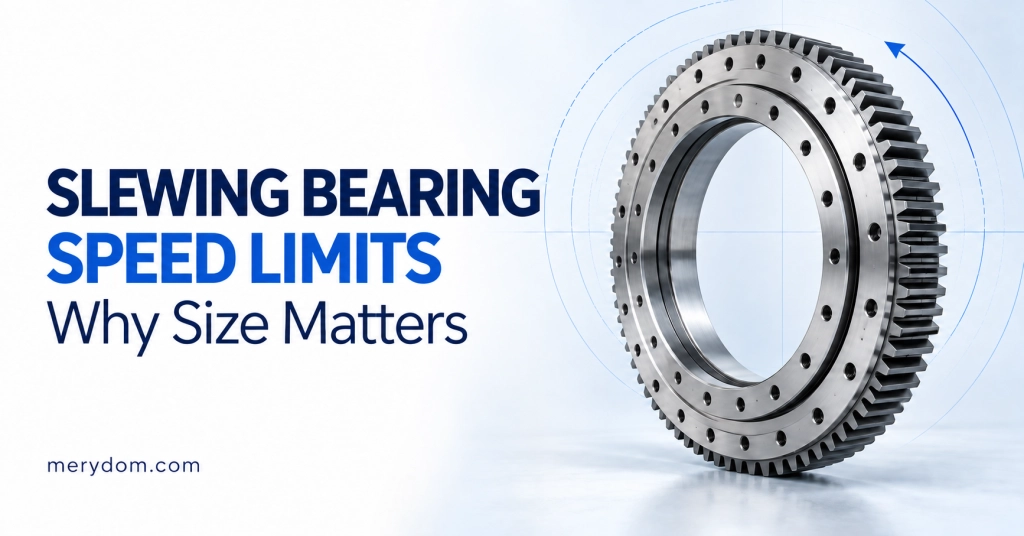
A slewing bearing model number like 013.45.1250 is not a serial number — it is a compressed engineering drawing. Every digit encodes a structural decision: rolling element type, raceway rows, gear position, ball size, pitch diameter. Read fluently, the designation tells you whether a bearing fits your machine before you open a single table. This guide decodes the full system used across the Chinese standard series (the 010/011/013…131/133 families, derived from the JB/T industry standard and used worldwide), with worked examples and the traps that catch even experienced buyers.
The full nine-segment code
The complete designation carries nine fields. Using the catalogue example 0 1 2 . 45 . 1800 0 0 2 11:
| Segment | Example | Meaning | Values |
|---|---|---|---|
| 1 — Product type | 0 | Rolling element family | 0 = ball · 1 = roller · 2 = ball-and-roller combination |
| 2 — Raceway rows | 1 | Number of raceway rows | 1 = single · 2 = double · 3 = three row |
| 3 — Transmission | 2 | Gear position and module class | 0 = no gear · 1 = external, small module · 2 = external, big module · 3 = internal, small module · 4 = internal, big module |
| 4 — Rolling element Ø | 45 | Ball or roller diameter, mm | catalogue steps: 20, 25, 30, 40, 45, 50, 60, 75… |
| 5 — Raceway centre Ø | 1800 | Pitch diameter DL, mm | the size key of the whole system |
| 6 — Assembly match | 0 | Front edge execution | 0 = none · 1 = front edge · 2 = special |
| 7 — Mounting holes | 0 | Through vs tapped | 0 = both through · 1 = both tapped · 2 = inner tapped/outer through · 3 = inner through/outer tapped |
| 8 — Seal type | 2 | Sealing execution | 0 = none · 1 = single ring seal · 2 = double ring seal |
| 9 — Material | 11 | Ring material code | per manufacturer’s material table |
In daily commerce the code is abbreviated to its first three fields plus dimensions — 013.45.1250 — because those five values identify the interface. The trailing fields matter at order (tapped holes, seals, material) and are fixed on the drawing.
Reading 013.45.1250 like an engineer
Walk the short code left to right. 0 — ball bearing. 1 — single row. 3 — internal gear, small module. So "013" alone already says: single-row four-point contact ball slewing bearing with an internal gear — the classic excavator and loader-crane structure. 45 — Ø45 mm balls, which places it in the mid-size capacity band. 1250 — raceway pitch diameter 1,250 mm, from which every other dimension of the family follows. One number, and you already know it competes with the 013/014 series table row where D = 1,390, d = 1,110, H = 110 mm.
Sister series: the logic that makes cross-checking possible
Here is the system’s most useful property: series that share everything except the gear. 010.45.1250, 011.45.1250 and 013.45.1250 have identical ring dimensions, mounting holes and raceway — they differ only in being ungeared, external-gear and internal-gear executions. The same triplets run through every family: 020/021/023 (double-row ball), 110/111/113 (crossed roller), 130/131/133 (three-row roller). Practical uses: if a supplier’s table value looks suspicious, check it against the ungeared sister — the dimensions must match (we used exactly this cross-check to validate our own 562-model database); and if your design later adds or moves the slew drive, the sister series is a drop-in on the same interface.
The even-numbered twins (012, 014, 022, 024, 112, 114, 132, 134) share dimensions with their odd siblings and differ in gear execution — the paired table rows carry separate module/teeth options and separate circumferential force ratings for normalized versus quench-hardened teeth.
The envelope trap: D is not the biggest diameter
The designation’s transmission digit warns you about the code’s most expensive misreading. On external-gear series (011, 021, 111, 131), the gear tip diameter De is larger than the listed outer diameter D — 011.40.800 has D = 922 mm but the gear reaches De = 966.4 mm, and that is what your structure must clear. On internal-gear series (013, 023, 113, 133), De is smaller than the bore d — the largest shaft or hose bundle that passes through 013.40.800 is De = 635.2 mm, not d = 678. Our model tables list Max OD and Min bore envelope values per model for this reason; when reading any manufacturer’s table, apply the rule yourself: envelope OD = max(D, De), envelope bore = min(d, De).
Identifying a bearing from its marking — and without it
A ring’s stamped marking normally carries the designation plus manufacturer and date. When corrosion has eaten it, the designation can be reconstructed from measurement: count raceway rows from the section (visible at the seal gap or grease ports), locate the gear (external / internal / none) for the third digit, measure ball diameter through a grease port or from the fill-plug bore, and take the raceway pitch diameter as roughly the mean of D and d, then round to the nearest catalogue step (…1000, 1120, 1250, 1400…). Match the reconstruction against the series tables and confirm on bolt-circle diameters and hole counts — two values that never lie. For excavator rings this whole workflow is built into the Excavator Bearing Finder; for anything else, photos and a dimensioned sketch through the RFQ channel get an engineering identification within a working day.
Where other systems fit
European manufacturers use proprietary designations (letter-based series codes) that do not decode digit-by-digit, but the underlying variables are identical — structure, gear position, rolling element size, pitch diameter. Cross-referencing therefore always routes through dimensions, never through code similarity: interface first (D, d, H, bolt circles, hole count/size), gearing second (teeth, module), designation last. If a quotation ever claims equivalence on the code alone, ask for the dimension comparison.
FAQ
What does 013.40.1000 mean?
Single-row four-point contact ball slewing bearing (0, 1), internal gear small module (3), Ø40 mm balls, raceway pitch diameter 1,000 mm.
What is the difference between 011 and 012 series?
Same ring dimensions; paired gear executions with different module/tooth options — the tables list normalized and quench-hardened tooth force ratings per variant.
Is the outer diameter D the largest diameter of the bearing?
Not on external-gear series — the gear tip De exceeds D and defines the true envelope. On internal-gear series De is smaller than the bore d and defines the minimum through-opening.
How do I identify a slewing bearing with no readable marking?
Reconstruct the designation from structure (rows, gear position), ball diameter and pitch diameter, then confirm against series tables using bolt-circle diameters and hole counts.
Are these designations an international standard?
They originate from the Chinese JB/T industry standard system and are used by manufacturers worldwide; European brands use proprietary codes, so cross-referencing is always done through dimensions.