Compare internal, external and ungeared slewing bearings by envelope, pinion access, protection, lubrication, backlash and manufacturing requirements.
The gear position on a slewing bearing affects much more than the outline drawing. It changes the pinion location, available structure, protection from contamination, inspection access, lubrication route and replacement procedure. Internal and external gear versions can use similar raceway structures, yet create very different machine interfaces.
This comparison helps designers choose a gear arrangement before selecting a model. Dimensional options can then be screened in the standard slewing bearing model catalogue, where external, internal and ungeared series are organized separately.
External gear: accessible and easy to inspect
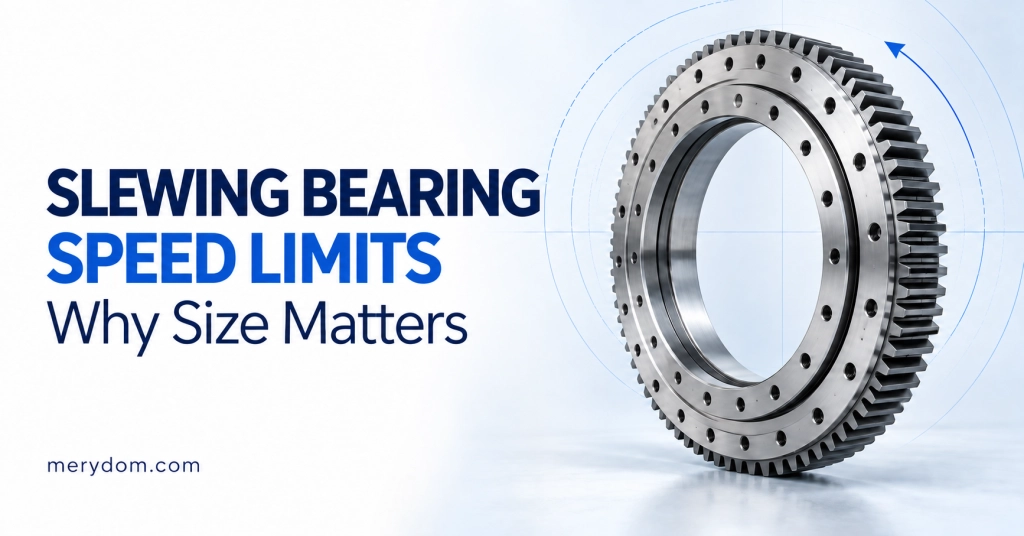
An external gear places the teeth on the outside diameter. The pinion is usually easy to position, observe and replace, and the large pitch diameter can reduce tangential tooth force for a given drive torque. External gearing also leaves the bearing bore available for hoses, cables, a central swivel or structural members.
The trade-off is exposure. Gear teeth may need guarding from personnel, impact, dust, rain and cargo debris. The maximum machine envelope must include the gear tip diameter and pinion assembly, not merely the bearing outside ring diameter. Lubricant thrown from an open gear also needs collection and housekeeping provisions.
Internal gear: protected and compact outside
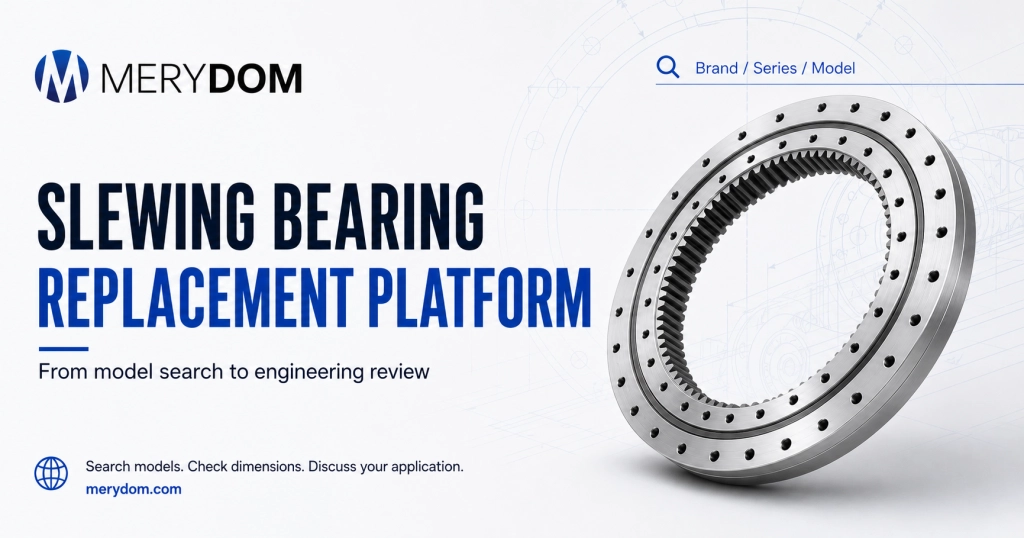
An internal gear moves the teeth and pinion inside the bearing bore. This can create a clean external envelope and offer useful protection from direct impact or environmental contamination. The arrangement is common when the surrounding machine structure must remain close to the bearing outside diameter.
Internal access can be more difficult. The pinion, lubrication points and inspection window compete with hydraulic swivels, cables and structural members. The usable center opening is controlled by the gear root and pinion space, so check the minimum free bore rather than the nominal ring inside diameter. Replacement planning should consider whether the pinion can be removed without lifting the entire upper structure.
Ungeared bearings and alternative drives
An ungeared slewing bearing is appropriate when torque is transmitted by a direct-drive motor, friction wheel, chain, belt or separate ring gear. Removing integral teeth can simplify the bearing and avoid gear requirements that do not match the selected drive. It may also suit precision tables where a torque motor acts directly on the rotating ring.
The alternative drive still needs a defined load path. Check how torque enters the ring, whether clamping loads distort the raceway, and how the drive is aligned and serviced. A separate gear must have its own datum, material, heat treatment, accuracy and attachment specification.
Gear calculations that apply to both arrangements
Calculate maximum pinion tangential force from the actual start, brake, emergency and wind torque at the gear pitch diameter. Verify tooth-root bending, contact stress, face width, module, pressure angle, material and hardness. Motor nominal torque alone is rarely the complete design case because gearbox ratio, efficiency, brake release and control limits change the peak at the pinion.
Backlash must be set at the tightest point of the gear circumference and rechecked after final bolt tightening. Ring deformation, pinion shaft deflection and mounting eccentricity can make backlash vary around the circle. The installation article on bolt preload and tightening sequence explains why the final mesh check comes after the joint is secured.
- Confirm module, tooth count, pressure angle and any profile modification.
- Define gear quality, hardness pattern and inspection records.
- Provide adjustment travel for pinion backlash.
- Separate raceway grease from open-gear lubricant requirements.
- Design safe access for inspection without exposing personnel to moving teeth.
A practical arrangement decision
Choose external gear when pinion access, a clear center opening and straightforward inspection dominate. Choose internal gear when outside envelope and tooth protection dominate and adequate internal service space exists. Choose ungeared when the machine uses a different torque-transmission concept. In every case, compare the complete installed arrangement rather than bearing price alone.
FAQ
Is an internal gear stronger than an external gear?
Not inherently. Capacity depends on pitch diameter, module, face width, material, heat treatment, pinion geometry and the real torque spectrum.
Which arrangement is easier to maintain?
External gears are often easier to inspect, while internal gears are better protected. Actual access and guarding determine the result.
Can the drive torque be used as the bearing tilting moment?
No. Drive torque and overturning moment are different load components and require separate checks.
Engineering references
For a drawing-based review, send MERYDOM the application, load cases, dimensions and required documentation. Final selection and service instructions must follow the approved drawing and equipment manufacturer requirements.