
A truck-mounted crane earns its living by cycling: load on, slew, load off and slew back, often repeatedly during the same job. Its slewing bearing sits at the column base inside the tightest installation envelope in the crane family, so selection is driven by duty, drive protection, interface stiffness and serviceability as much as peak capacity.
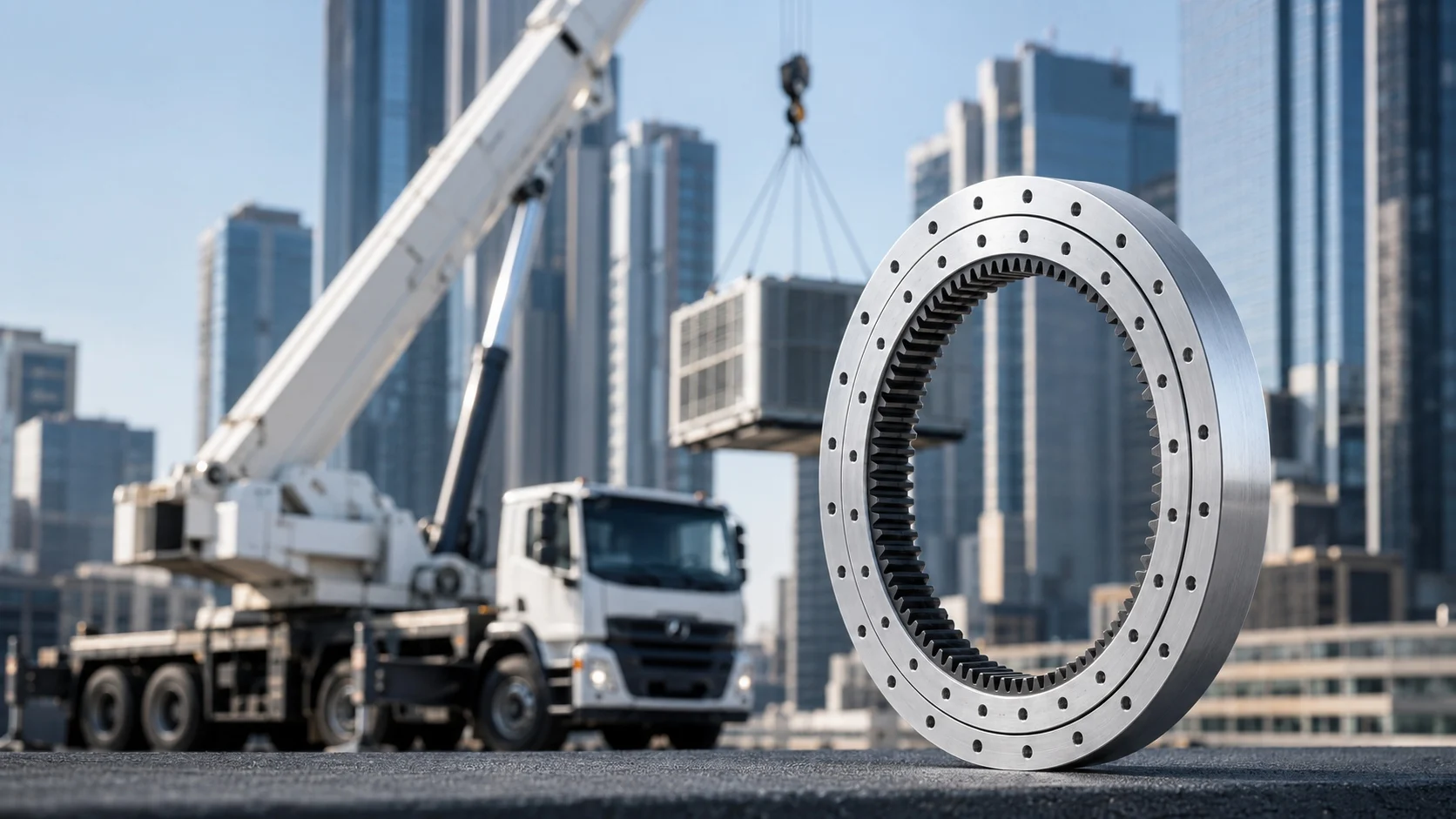
The column base: a different mounting problem
Unlike a turntable crane, a knuckle-boom crane rotates a tall column. Column bending and fabricated-base distortion feed directly into the bearing seat, so support-surface flatness and stiffness are as important as bearing quality. Flanges should be finish-machined after welding and stress-relief processes defined by the crane manufacturer; mounting bolts must not be used to pull a distorted seat flat.
The joint can also see high alternating moment with relatively little stabilising axial load. Bolt grade, quantity, preload, lubrication condition, tightening sequence and re-check interval must follow the verified crane design. Where the bolting check governs, the solution may be a larger bolt circle, additional fasteners or a stiffer interface rather than simply a higher-capacity raceway.
Seat and column stiffness
Control flange flatness after fabrication and confirm that the column and base do not concentrate load on a short raceway arc.
Bolted-joint control
Use calibrated tools, the specified friction condition and a documented tightening sequence so the assumed preload exists in service.
Why internal gear rings dominate this segment
Internal gearing allows the pinion to sit inside the column base, protected from road spray, jobsite impacts and direct washdown. The 013/014 internal-gear series is therefore a common starting structure for compact loader-crane designs. External-gear 011/012 series remain useful where the slew drive is outside the column for service access or retrofit compatibility.
Internal gearing creates a critical packaging check: the gear-tip diameter may be smaller than the nominal ring bore. Hoses, harnesses, rotary joints and the pinion must fit within the true minimum opening, not only the body bore shown on a simplified layout.
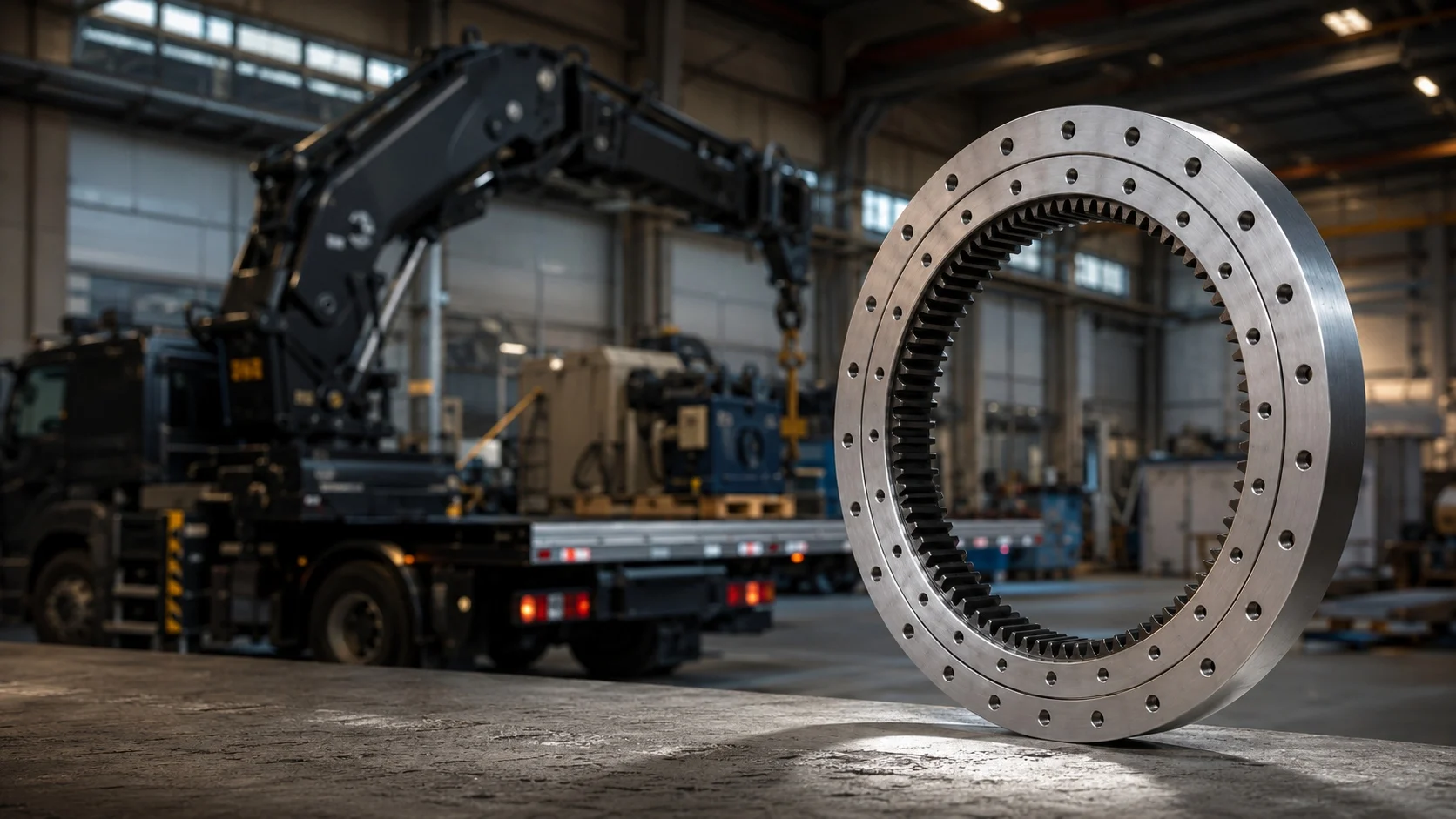
Verify maximum outside diameter for external-gear rings and minimum internal envelope for internal-gear rings against the complete column, drive and hose layout.
High-cycle duty: what actually wears
Loader cranes accumulate many short arcs, reversals and load changes. Work may concentrate on the side sector used for loading, while grease is repeatedly displaced from the same contacts. The purchase specification should therefore define raceway hardness and effective case depth, controlled internal clearance, seal material, gear condition and the required records for each production batch.
- Hardness-transition positionMark the induction-hardening transition and orient it in the low-load sector specified by the crane designer.
- Washdown protectionDo not direct high-pressure water at the seal gap. Inspect seals and relubricate after severe washdown or contamination.
- Cycle-based lubricationSet the grease interval from the machine duty and rotate as required so fresh grease is distributed around the raceway and gear.
Replacing a loader-crane slewing ring
Replacement identification normally requires the ring marking, bolt circles, hole pattern, ring heights, tooth count and module. Clear photographs plus a dimensioned sketch allow MERYDOM engineering to match a catalogue interface or prepare a made-to-drawing quotation. The same structured identification logic used by the Excavator Bearing Finder applies to crane references.
An early failure should not be copied without review. Seat distortion, lost bolt preload, contamination, overload or changed duty may be the real cause. Include the failure description and operating history so the replacement specification can address the system, not only the ring.
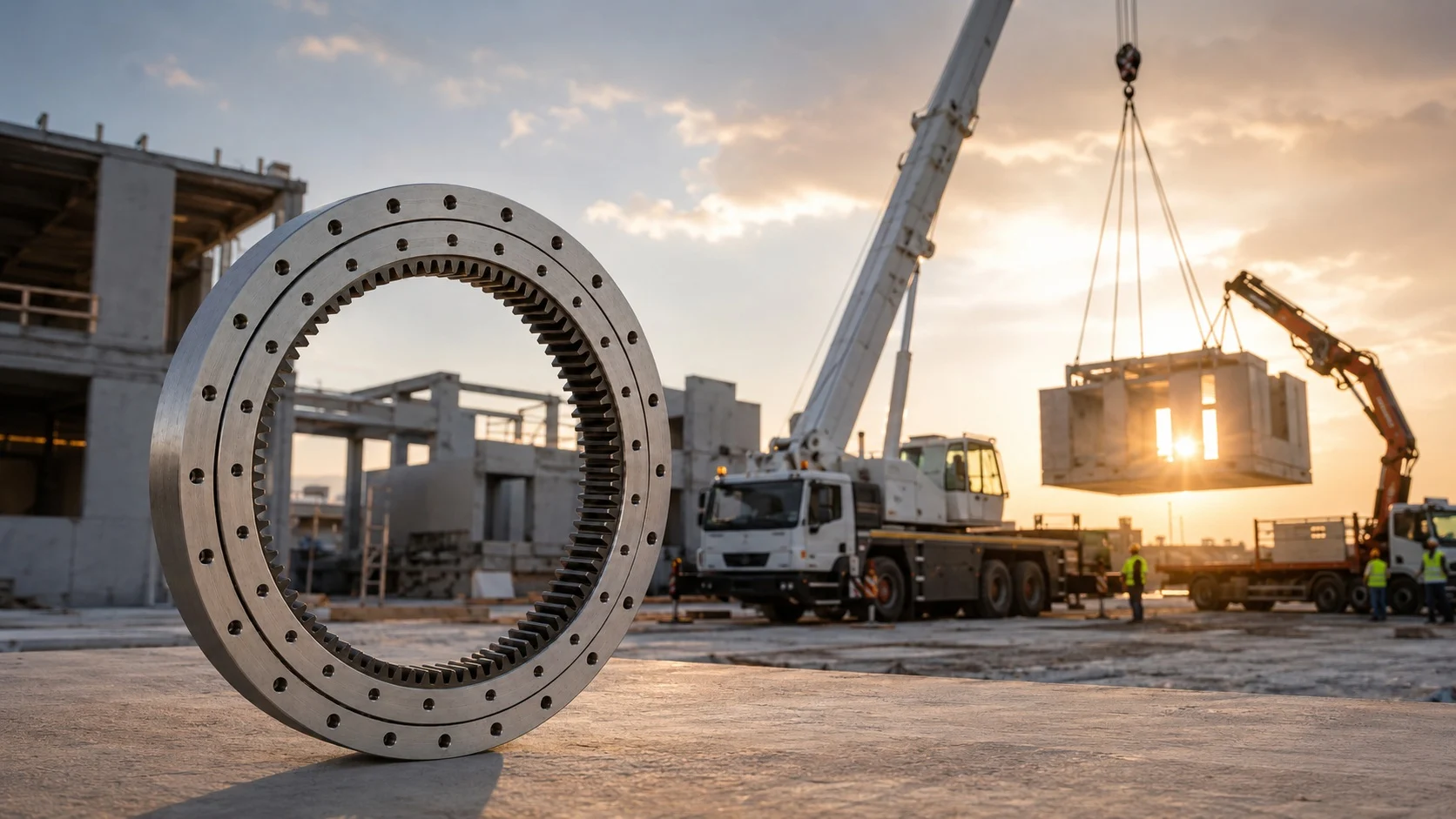
For European loader-crane projects, EN 12999 is an important machine-level design context. Bearing documents such as EN 10204 material certificates, dimensional reports, hardness records and traceability are supplied to the agreed purchase specification; the bearing itself is not independently declared compliant with the complete machine standard.
Truck-Mounted Cranes slewing bearing FAQ
Which slewing bearing fits a knuckle-boom loader crane?
A single-row four-point contact ball bearing with internal gear is a common starting structure because the drive can remain protected inside the column base. External-gear designs are also used where the slew drive is mounted outside. Final selection requires the actual load cases, bolt interface, support stiffness and duty cycle.
Why do loader-crane bearings often use internal gears?
The pinion and gear mesh can be contained inside the column base, protecting them from road spray, impacts and washdown while keeping the drive package within the vehicle envelope.
How is a replacement ring identified?
Provide the existing marking, overall and interface dimensions, bolt-circle diameters, hole count and size, ring heights, tooth count and module if known. Clear photographs and a dimensioned sketch are normally enough for engineering review.
How often should a loader-crane slewing bearing be greased?
Use the crane manufacturer maintenance interval, preferably linked to operating or slewing hours rather than calendar time. Rotate through the specified travel during greasing and relubricate after pressure washing or severe contamination exposure.
What is the usable opening on an internal-gear ring?
The gear-tip diameter can be smaller than the nominal ring bore. Hoses, harnesses and the drive pinion must be checked against the minimum internal envelope shown in the model data or project drawing.
Send the column interface and governing load cases
Include the crane model, load spectrum, support drawing, bolt pattern, gear layout, operating cycles, environment and required documentation.