
Replacing a tower-crane slewing bearing can require a mobile crane, site restrictions and major jib disassembly. That changes the engineering priority: predictable service life, controlled bolting, condition trending and verifiable quality records matter as much as nominal bearing capacity.

The tower-crane load case: a moment that changes sides
On a hammerhead or trolley-jib tower crane, the counter-jib and ballast oppose the jib-side load. With the trolley close to the tower or the hook lightly loaded, the net tilting moment can act toward the counter-jib; as the trolley moves outward and the lifted load increases, the governing moment moves toward the jib. The slewing bearing and bolt circle must therefore be reviewed for both load directions, not only one maximum case.
Reverse cycling repeatedly loads different raceway sectors and alternates tension demand around the bolt circle. This is one reason 011/012 external-gear and 013/014 internal-gear single-row four-point contact ball structures are common starting points for tower-crane design: their geometry supports combined loads in both moment directions.
Raceway duty
Both working sectors may accumulate fatigue cycles as trolley radius, hook load, wind and crane configuration change.
Bolted-joint duty
A flexible mast and reversing moment make full preload, flange contact and repeatable tightening control essential to joint integrity.
Bolt grade, lubrication condition, tightening method, reuse policy and inspection interval must follow the crane OEM drawing and erection procedure. A general web page cannot replace the approved connection calculation.
Erection cycles: a duty few other crane systems experience
A construction tower crane may be erected, climbed, relocated and dismantled repeatedly during its service life. Each cycle disturbs the interface on which the bearing depends: the flange faces, mounting bolts and contact conditions between the rings and the mast or slewing platform.

- Inspect the flange facesRemove burrs, corrosion, paint build-up and fretting debris before assembly.
- Follow the approved bolt policyRenew or reuse fasteners only under the crane manufacturer’s documented procedure.
- Restore controlled preloadUse calibrated tools, the specified tightening sequence and the defined thread condition.
- Record condition consistentlyMeasure tilt clearance or axial movement at repeatable positions and compare the trend across service intervals.
A single clearance value is less informative than a controlled trend. Rising movement, increasing slewing-drive current, abnormal noise or metallic-grey grease should trigger engineering review before the crane becomes unavailable at height.
Why documentation carries more weight at tower height
Tower cranes work above active sites and public areas, and their technical files may follow the machine across projects, owners and countries. For projects governed by European tower-crane requirements, the complete machine is commonly evaluated against EN 14439 and the applicable national regulations; the bearing documentation supports that machine-level file rather than replacing it.
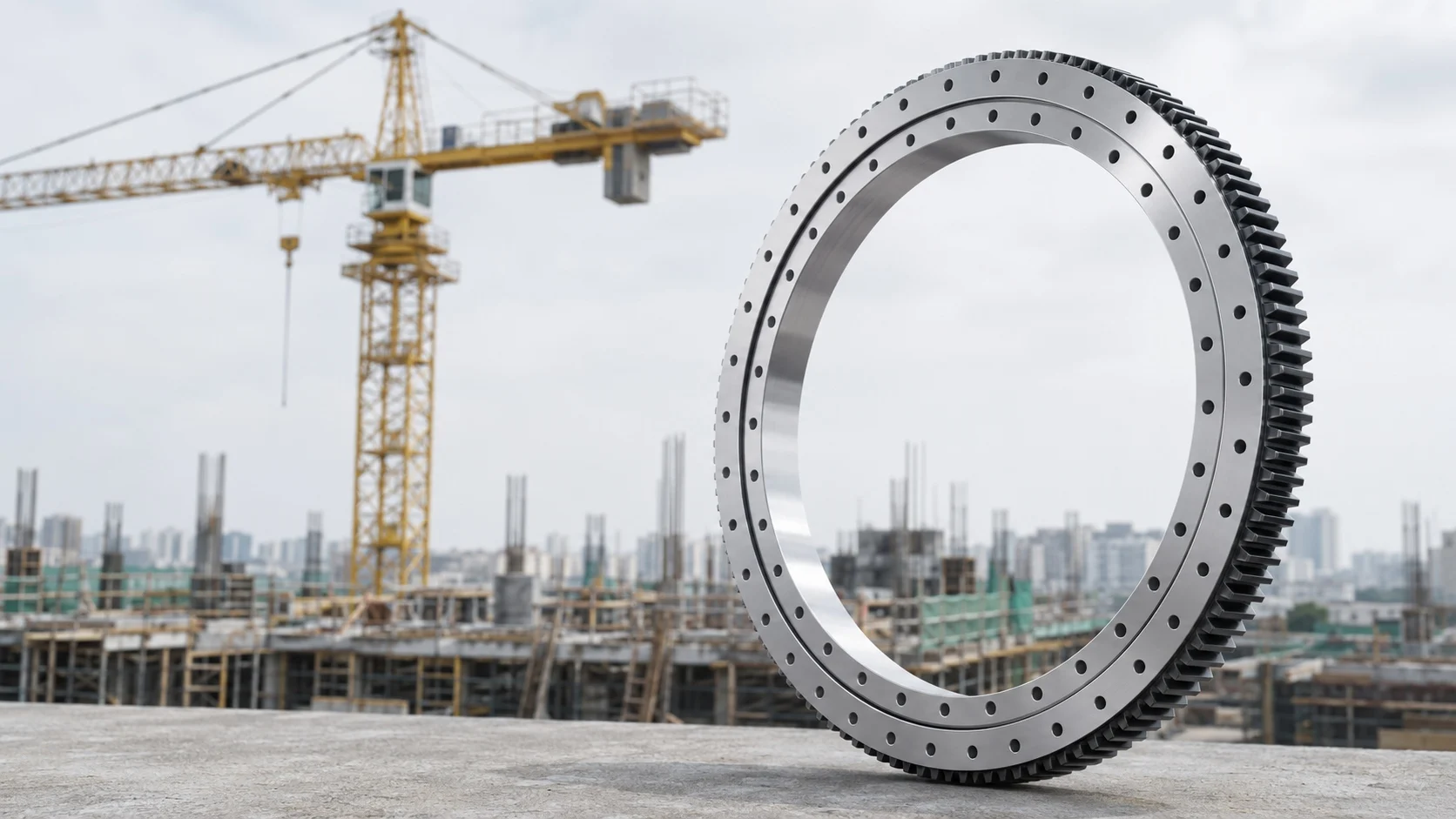
A practical bearing documentation package can include EN 10204 3.1 material certificates, dimensional and clearance reports, raceway hardness and effective-case-depth results, serial traceability and specified ultrasonic or magnetic-particle inspection records. The induction-hardening transition zone should be identified so the installation drawing can position it outside the principal working sector where required.
Review our published inspection capability and traceability system to see how measurement and identity records are controlled. Third-party witnessed documentation can be agreed before production when the project requires it.
Replacement planning: downtime economics shape the specification
Replacing a tower-crane slewing ring usually costs far more than the bearing alone. Fleet owners therefore increasingly plan the replacement from condition trends rather than waiting for a breakdown. Identification normally starts with the existing marking, interface dimensions, height, tooth count, module, hole pattern and photographs. A dimensioned sketch or original drawing allows MERYDOM engineering to compare a standard interface or quote a drawing-based replacement through the RFQ channel.
A used ring with no verified load history, inspection status or traceability introduces an unknown into a safety-sensitive machine. A documented new component from an auditable manufacturer protects the much larger costs of site shutdown, lifting support, dismantling and regulatory review. MERYDOM publishes its factory evidence and supplier qualification information so buyers can verify the production source before placing an order.
Tower crane slewing bearing FAQ
Which slewing bearing type do tower cranes use?
Single-row four-point contact ball slewing bearings are widely used on many tower-crane classes because they can carry axial, radial and tilting-moment loads in both directions. External-gear 011/012 and internal-gear 013/014 series provide common starting geometries, but the final model must be checked against the actual crane loads, support structure and bolting interface.
Why can the tilting moment reverse on a tower crane?
On a trolley-jib tower crane, the counter-jib and ballast oppose the jib-side load. As trolley position and hook load change, the net tilting moment can move from one side of the slewing interface to the other, cycling both raceway sectors and both sides of the bolt circle.
How can tower-crane slewing-ring wear be monitored?
Use the crane OEM procedure to record tilt clearance or axial movement at consistent positions and conditions. A rising trend, increasing slewing-drive current, abnormal noise or metallic contamination in grease should trigger engineering review rather than waiting for a breakdown.
Can tower-crane slewing-bearing bolts be reused?
Only when the crane manufacturer, fastener specification and inspection procedure explicitly permit reuse. Repeated erection and reversing joint loads make the connection fatigue-sensitive, so bolt condition, lubrication, preload method and tightening records must follow the project procedure.
What documents should a replacement tower-crane slewing ring include?
The agreed package commonly includes EN 10204 3.1 material certificates, dimensional and clearance reports, raceway hardness and effective-case-depth results, traceability information and specified NDT records with the hardness-transition zone identified. Third-party witnessed documentation can be agreed when required.
Send the interface drawing and operating load cases
Include the crane type, load combinations in both moment directions, bearing envelope, gear data, bolt pattern, erection history and required documentation.