
This page explains how crane duty differs from other slewing applications, which bearing structures fit purpose-built truck, all-terrain, rough-terrain and crawler cranes, and what crane OEMs and rebuilders should specify before ordering. Truck-mounted loader cranes and knuckle-boom cranes remain a separate application family because their compact vehicle integration and cycle profile are different.
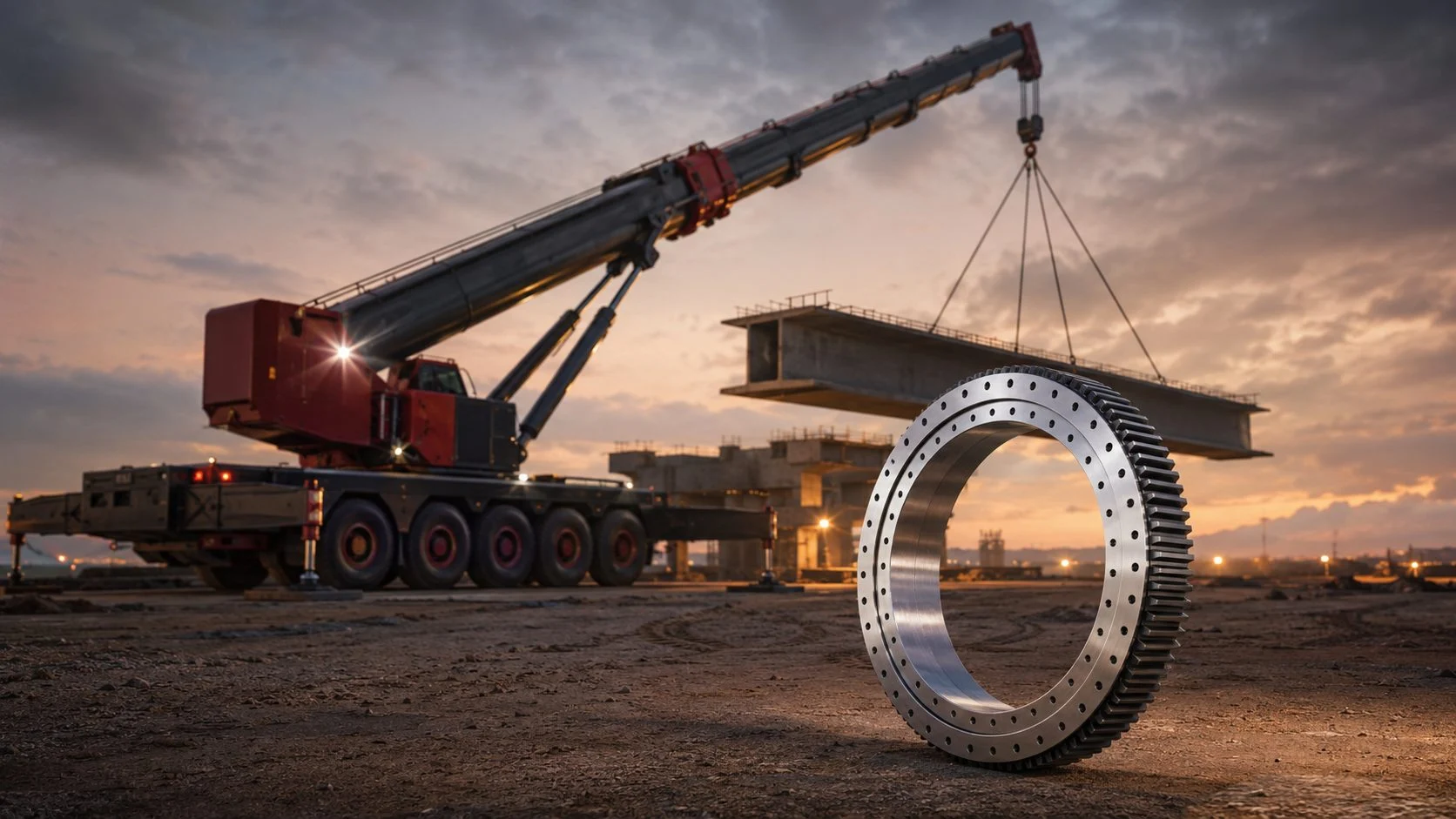
Why crane duty is different: the overturning moment governs everything
Most rotating equipment loads a slewing bearing mainly in the axial direction. A crane does the opposite. When the boom extends and lifts a load at radius, the tilting moment Mk can grow much faster than the axial load Fa. A critical working condition may therefore be a relatively light load at maximum radius, rather than the heaviest nominal lift.
Under high Mk and comparatively low Fa, one side of the bearing is pressed down while the opposite side tends to lift, placing the mounting bolts in tension and cycling the raceway contacts through their extremes. Crane selection is therefore not based on static capacity alone.
Raceway capacity curve
Checks peak rolling-contact stress and the risk of permanent deformation in the hardened raceway.
Bolting capacity curve
Checks bolt preload, joint separation and bolt fatigue under the governing moment load.
A bearing can pass one curve and fail the other. On long-boom machines, the bolting curve frequently becomes the governing limit. Preliminary catalogue methods may use service factors around fL = 1.5 for mobile cranes and around 1.33 for service-crane duty, but the final factor must follow the crane OEM calculation method, applicable standard and operating conditions.
Raceway NDT, induction-hardening transition-zone marking, gear inspection and the final documentation package should be defined in the drawing, inspection plan or purchase specification.
All-terrain, rough-terrain and truck cranes: where capacity classes climb
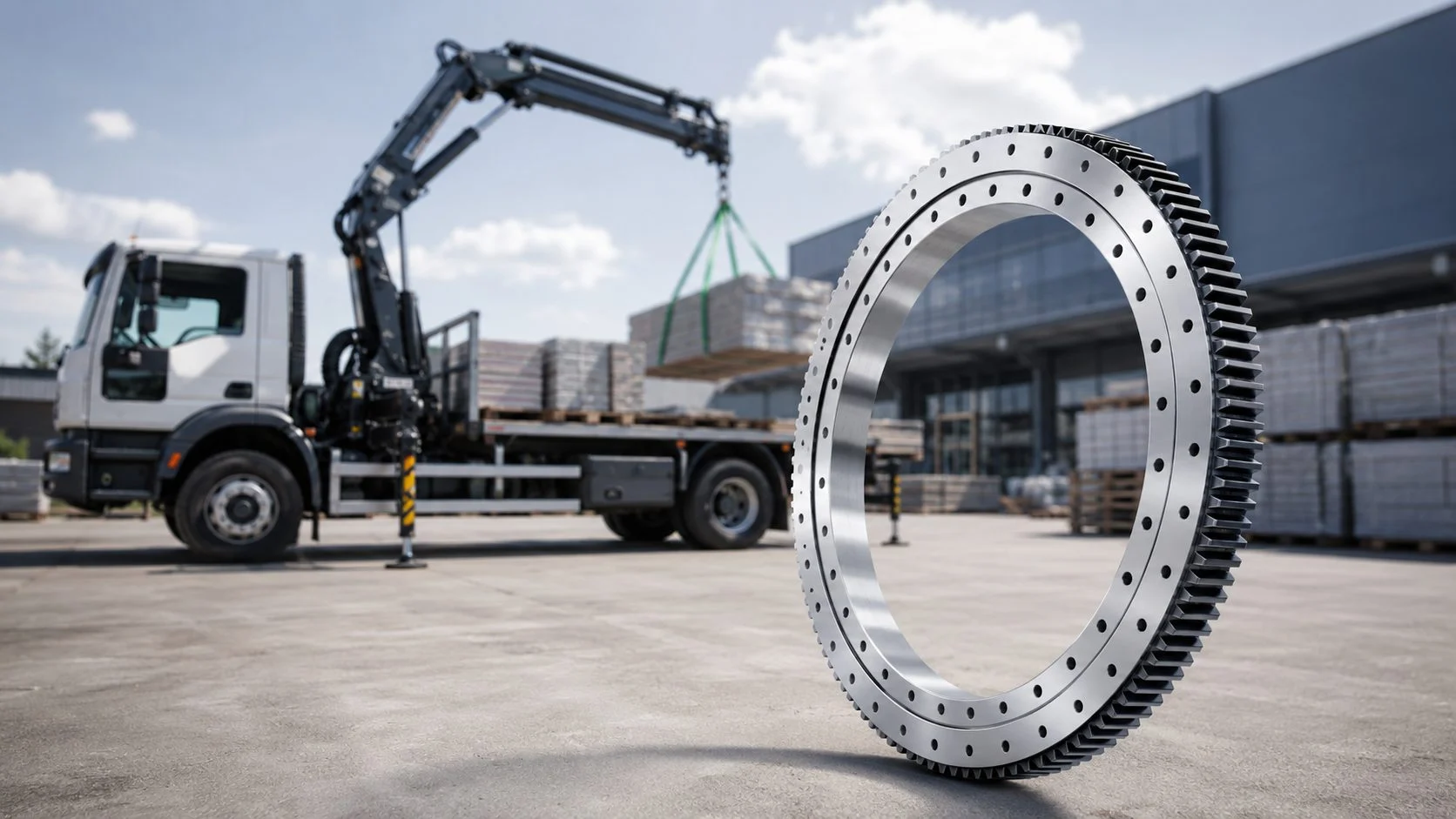
Purpose-built truck cranes, all-terrain cranes and rough-terrain cranes combine high overturning moments with strict packaging around the carrier and turntable. Smaller and mid-class machines commonly begin with single-row four-point contact ball slewing bearings: 011/012 external-gear series or 013/014 internal-gear series.
As lifting capacity moves from approximately the 25–60 t class toward 100 t and beyond, a single-row ball structure may reach its economic limit for combined Mk + Fa. Mid-class machines can step up to 021/022 external-gear double-row ball bearings or 023/024 internal-gear double-row ball bearings, increasing axial and moment capacity within a controlled diameter envelope.
Two system-level points decide whether the calculated capacity is achieved in the machine. First is support-structure stiffness: if the turntable or carrier deck deflects under moment, load concentrates on a short raceway arc. Second is bolt-preload discipline: the bolting-capacity curve is valid only when the specified bolt grade, lubrication condition, tightening method and achieved preload are present.
Crawler cranes: three-row roller territory
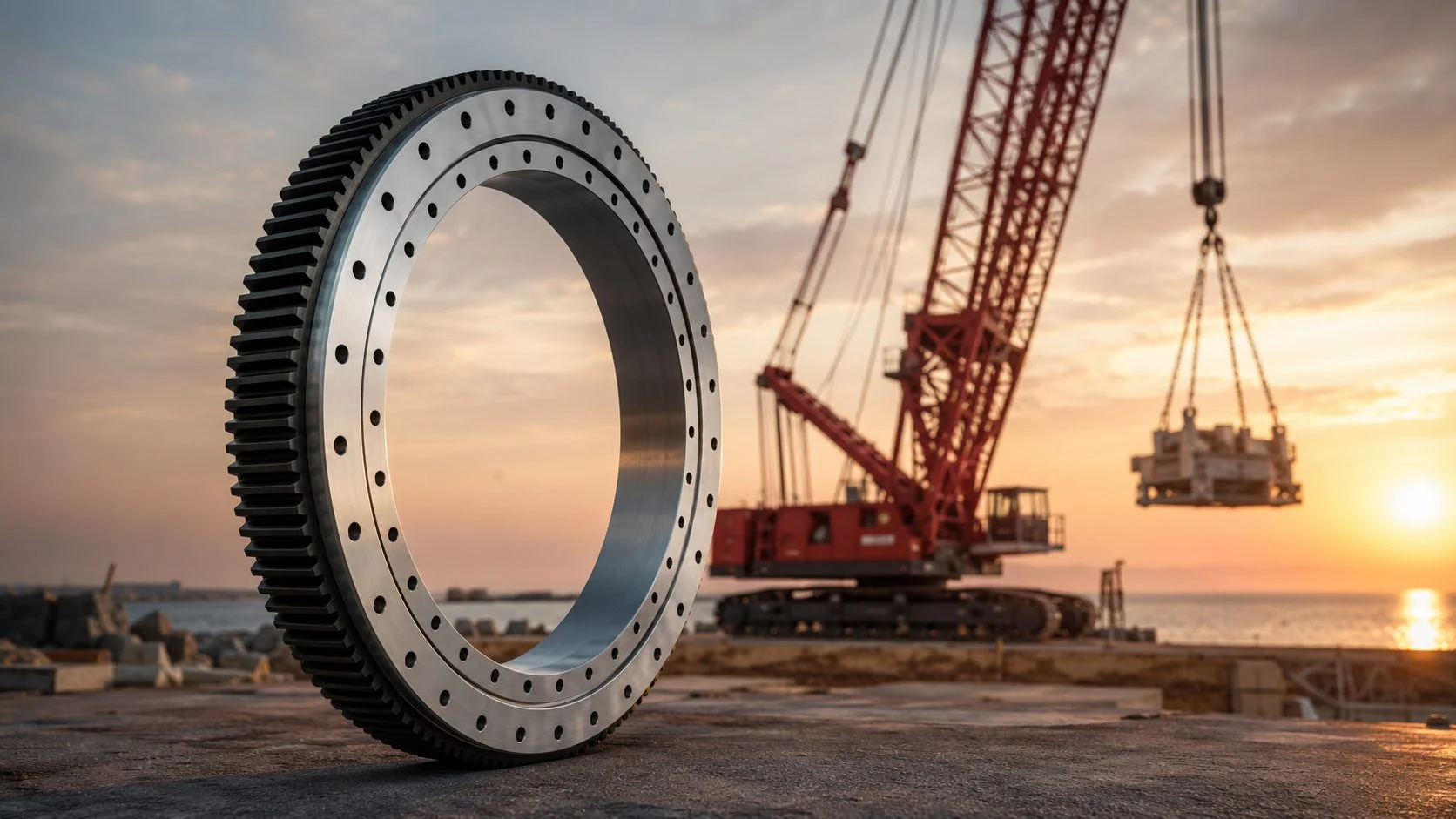
Crawler cranes combine some of the largest moments in the mobile-crane family with low slewing speeds, heavy structures and long service lives. The standard high-capacity answer is the three-row roller slewing bearing: 131/132 external-gear, 133/134 internal-gear, or 130 ungeared series.
Separate roller rows carry axial load, radial load and overturning moment, giving very high static capacity per unit diameter. Rings in this class can extend to approximately Ø4,000 mm and beyond. For heavy crane duty, 42CrMo quenched-and-tempered steel is commonly specified, with induction-hardened raceways and hardened gear teeth where required.
Because the load-carrying rows are separated, three-row roller bearings are particularly sensitive to the stiffness and flatness of both connecting structures. Crawler-crane OEMs therefore commonly require seating-surface measurements, bolt-preload records and mounting-structure confirmation alongside the bearing inspection documents.
What crane OEMs should specify: the six-line checklist
A crane RFQ containing the following six items can normally be reviewed and quoted with fewer clarification cycles:
- Load caseMk, Fa and Fr for the governing conditions, or the load chart and geometry needed to derive them, plus the intended service factor.
- Raceway hardeningRequired surface hardness, commonly 55 HRC or above, and the effective hardened depth appropriate to the rolling-element size and duty.
- NDT scopeUltrasonic or magnetic-particle inspection requirements, transition-zone identification and any customer witness or reporting requirements.
- GearingModule, tooth count, internal or external gear, hardened or unhardened flanks, gear quality and required backlash.
- Bolting interfaceHole pattern, through holes or tapped holes, bolt grade, clamping length and the assumptions used in the bolting-capacity check.
- DocumentationEN 10204 3.1 material certificates, dimensional, hardness and clearance reports, traceability records, and any agreed third-party witnessed documentation.
If any of these items remain open, send the drawing and application through our Load Case Review. MERYDOM engineering will review raceway and bolting requirements before quotation and identify any condition outside the verified range.
Replacement bearings for cranes in service
Crane slewing bearings are long-life wear components rather than lifetime machine structures. Rising slewing-drive torque, uneven rotation, metallic-grey grease, local noise or measurable tilt-clearance growth are common indicators that inspection is required.
For replacement projects, MERYDOM can support identification from the old bearing marking, interface dimensions, tooth count, gear data and machine information, then manufacture to the confirmed mounting interface. The workflow is similar to the model-identification logic used in our Excavator Bearing Finder, but crane projects additionally require the machine model, serial number, boom configuration and safety-document scope.
Manufacturing and supplier evidence you can verify
Crane OEMs and rebuilders normally require more than a catalogue match. MERYDOM publishes its factory environment, production equipment and supplier-qualification information. Current production activity and approved customer visit records help buyers verify that the manufacturing system is active and open to technical review.
Inspection capability, calibration control, product identification and traceability are documented under the MERYDOM Quality Control System.

Mobile crane slewing bearing FAQ
Which slewing bearing type is used on mobile cranes?
Single-row four-point contact ball bearings are common on smaller and mid-size machines. Double-row ball structures are used as combined axial and moment capacity rises, while large crawler and high-capacity mobile cranes commonly move into three-row roller structures. The final choice must be checked against the actual load cases and bolting interface.
Why can a crane bearing fail the bolt check while passing the raceway check?
At long radius the tilting moment can be high while axial load remains relatively low. That combination tends to lift one side of the joint and load the mounting bolts in tension, so the bolting-capacity curve may govern even when the raceway-capacity curve still passes.
What documentation should come with a crane slewing bearing?
The agreed package commonly includes EN 10204 3.1 material certificates, dimensional results, raceway hardness and effective-case-depth records, clearance or rotation checks, traceability information and any specified NDT records. Third-party witnessed documentation can be agreed for the project.
Can catalogue standard models be used for cranes?
Catalogue series are useful starting points for interface dimensions and structure selection. Crane duty still requires a project load-case check covering raceway capacity, bolting capacity, support stiffness, gear interface and the applicable service factor before a model is confirmed.
How long does a custom crane slewing bearing take?
A typical custom lead time is approximately 30 to 45 days, depending on diameter, material, heat treatment, gearing, inspection scope and documentation. The confirmed schedule is stated in the quotation after drawing review.
Send the crane load case and interface drawing
Include the governing moment, axial and radial loads, bearing envelope, gear data, bolt pattern, quantity and documentation requirements.