Understand why larger slewing bearings usually need lower rpm, how operating duty affects wear, and what to check before selecting or increasing speed.
An equipment designer may look at a large slewing bearing turning at 5 rpm and think: that is barely moving. In one sense, it is. But a point on a large circle travels much farther in each revolution than a point on a small circle. The rpm alone does not tell the whole story.
For comparable bearing designs and operating conditions, a larger rolling-element pitch diameter generally means a lower allowable rpm at the same circumferential-speed limit. This is why a speed that works for one slewing bearing cannot simply be carried over to a larger replacement.
This guide explains that relationship, what can go wrong when the approved speed is exceeded, and the information needed to choose a bearing that will last.
Why many slewing bearings are designed for slow movement
A slewing bearing often has to support a heavy structure, carry axial and radial forces, and resist an overturning moment—all within one compact assembly. On an excavator, crane or positioning platform, the job is usually to move and hold a load. Continuous high-speed rotation is not necessarily part of that job.
Silverthin describes its slewing rings as commonly used for slow, oscillating or intermittent motion and directs speed-limit calculations to its engineering team. That is a useful starting point for conventional applications, rather than a universal rpm rating for every slewing bearing. [1]
Special designs can operate faster. The important question is whether the particular bearing, lubrication arrangement and installation were designed for the required motion. A high load rating does not, by itself, establish a high speed rating.
Same rpm, different distance travelled
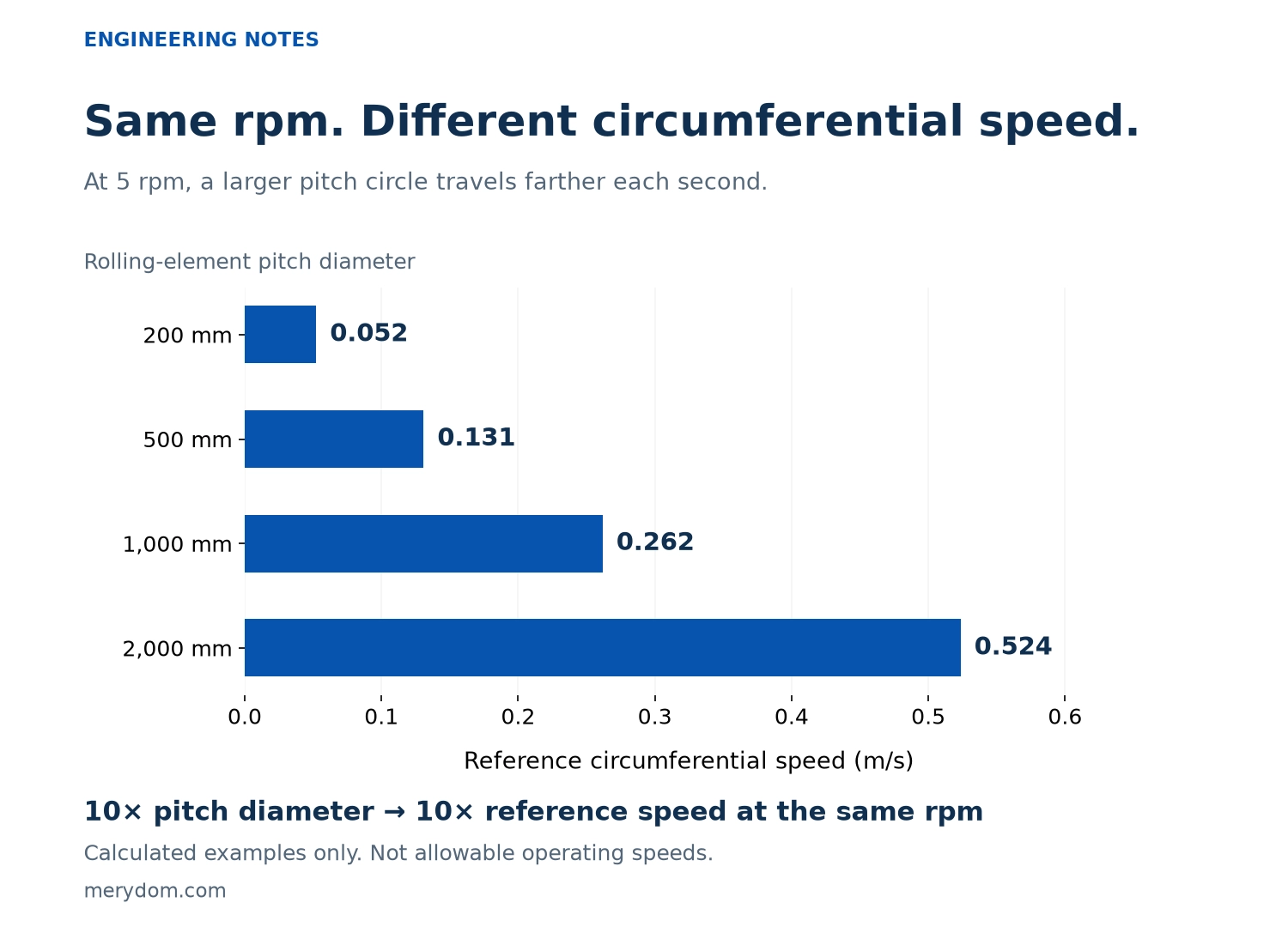
Imagine walking around two circular tracks. One is small; the other is ten times larger in diameter. To complete both laps in the same time, you must move ten times faster on the larger track.
The same geometry helps explain bearing speed. Consider two bearings with rolling-element pitch diameters of 200 mm and 2,000 mm. At 5 rpm, the reference circumferential speeds are approximately 0.052 m/s and 0.524 m/s. The larger one has ten times the reference speed, although both complete five revolutions per minute.
Only one equation is needed:
Use pitch diameter in metres to obtain speed in metres per second.
Here, rpm means the relative rotational speed between the bearing rings. The result is a geometric reference at the rolling-element pitch circle. It is not the actual speed of a ball orbiting the bearing, the ball’s spin speed, or the sliding speed inside a contact. Those require more detailed bearing kinematics.
Which diameter should you use?
Customers usually know the bearing’s outside diameter. For this calculation, the more relevant dimension is the diameter of the circle through the rolling-element centres, often identified as the rolling-element pitch diameter on a drawing.
Do not confuse it with the gear pitch diameter. Also, do not automatically substitute the average of the outside and bore diameters: on some designs that can be an estimate, but it is not a confirmed raceway dimension. Multi-row designs may require consideration of more than one row.
Outside diameter remains a useful first description of size. The engineering check should use the appropriate internal geometry supplied by the manufacturer.
Why the allowable rpm usually falls as diameter increases
If a comparable bearing family is limited to the same circumferential speed, doubling the pitch diameter halves the corresponding rpm. Increasing the diameter tenfold reduces it to one tenth.
This relationship explains the trend. It does not supply the speed limit itself.
Schaeffler’s Catalogue 404 lists maximum circumferential speeds with grease lubrication and distinguishes bearing series and short-duration conditions. Its overview also qualifies the values by standard clearance. Kaydon’s Catalogue 390 gives pitch-line speed guidance tied to particular series and intermittent operation. These are examples of how manufacturers define the operating envelope; they are not ratings for an unspecified MERYDOM bearing. [2, 3]
Two bearings of the same outside diameter can therefore have different approved speeds. Their rolling elements, internal arrangement, clearance or preload, seals, lubricant and operating duty may differ. A purpose-designed large bearing can also exceed the rpm of a smaller bearing intended for a different job.
Use diameter to understand the trend. Use the specific bearing’s approved application data to set the operating speed.
What can happen when the bearing runs too fast?
Exceeding the approved speed can shorten service life and, in unfavourable conditions, cause rapid damage. There is no single failure sequence that occurs in every bearing. Three issues deserve particular attention.
1. More frictional power can become more heat
Friction resists rotation. If friction torque stayed unchanged, doubling rotational speed would double the rate at which frictional energy becomes heat. In a real bearing, torque also changes with the operating conditions.
SKF’s friction model separates rolling, sliding, seal and lubricant-drag contributions and describes the effects of lubrication conditions. It helps explain why speed cannot be assessed independently of the lubrication system. [4]
The practical question is whether the bearing can release the generated heat during its actual duty cycle. A short movement followed by a long rest and uninterrupted rotation can produce very different temperature histories.
2. The lubricant may no longer suit the operating condition
Lubricant must reach the contacts and provide adequate separation between surfaces. As operating temperature rises, oil viscosity generally falls. Whether an adequate film remains depends on load, speed, lubricant properties and lubricant supply; increasing speed does not automatically mean the film becomes thinner.
An unsuitable combination can leave contact surfaces insufficiently protected. Simply adding more grease is not a reliable correction: the right lubricant, quantity, distribution and replenishment interval must be established for the application. Our guide to slewing bearing lubrication and grease intervals explains the maintenance side of this decision.
3. Internal motion and separation need to remain controlled
Rolling elements do not move through a perfectly uniform load field. Load distribution, contact conditions and the design of the spacers or cage affect internal motion. At demanding speeds, the design review must consider sliding and separator behaviour as well as the load rating.
A 2024 study by Escanciano and colleagues shows that preload variation and support stiffness matter when predicting friction torque in ball slewing bearings. It reinforces an important selection point: the assembled system matters, not only the nominal dimensions. The study does not establish a universal overspeed threshold. [5]
For more on internal separation, see spacers versus cages in slewing bearings.
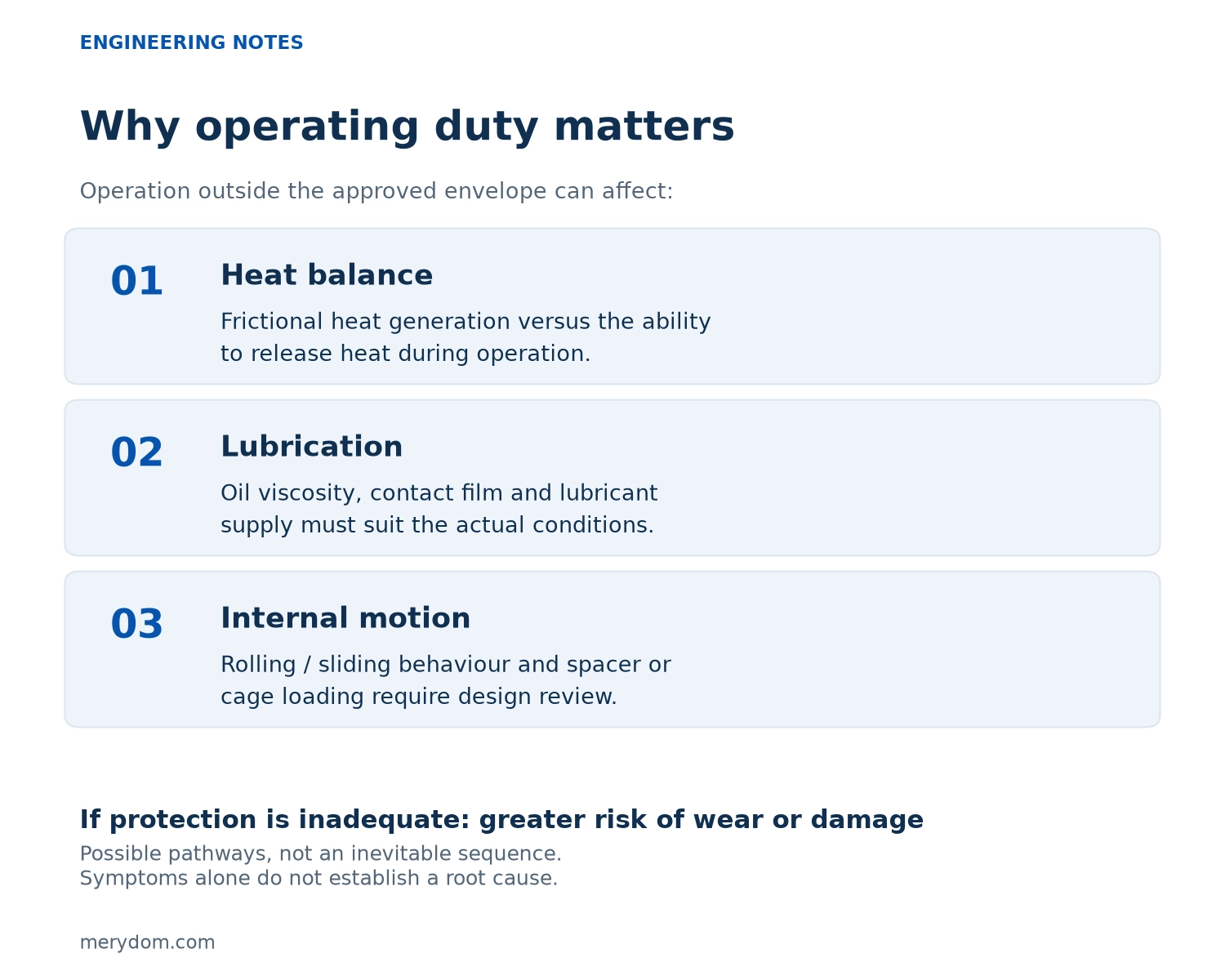
Possible outcomes include accelerated wear, surface distress and damage to separators or seals. Temperature changes, abnormal noise or increased running torque warrant investigation, but none identifies overspeed on its own. Contamination, mounting distortion, incorrect lubrication and excessive load can produce similar symptoms.
Five rpm for a few seconds is not five rpm all day
Consider a turntable that rotates for ten seconds, then remains stationary for several minutes. Now consider an otherwise similar machine that runs continuously at the same rpm. The second bearing experiences more revolutions over the working day and has less opportunity to cool between movements.
A useful specification therefore includes both how fast the bearing moves and how long it keeps moving. Record normal speed, maximum speed, time at maximum speed, starts and stops, acceleration, reversals and total operating hours.
Oscillation needs its own description. A bearing swinging repeatedly through a small angle cannot be fully described by an average rpm. State the angular stroke, frequency and motion profile. Research by Wandel and colleagues on grease-lubricated oscillating bearings examines how lubricant displacement and replenishment influence starvation. Slow movement is therefore not automatically easy on lubrication. [6]
What should an engineer check before approving a speed?
Start with the actual application rather than a generic diameter-to-rpm chart. The following information makes a speed review much more useful.
| Information | What to provide | Why it matters |
|---|---|---|
| Bearing and geometry | Model, drawing, pitch diameter and internal design | Identifies the correct speed guidance and reference diameter |
| Motion and duration | Normal and peak rpm, duration, acceleration and reversals; angle and frequency for oscillation | Separates continuous, intermittent and oscillating duty |
| Loads during motion | Axial force, radial force and overturning moment for each operating case | A stationary load case may differ from the rotating one |
| Lubrication and environment | Lubricant specification, delivery method, temperature range and contamination exposure | Supports assessment of lubricant supply and heat balance |
| Installation and acceptance | Support structure, mounting requirements, target life and agreed test conditions | Connects the bearing calculation to the assembled machine |
Our load-case calculation guide helps organise the forces and moments. If you are preparing an enquiry, the RFQ engineering package guide provides a useful companion checklist.
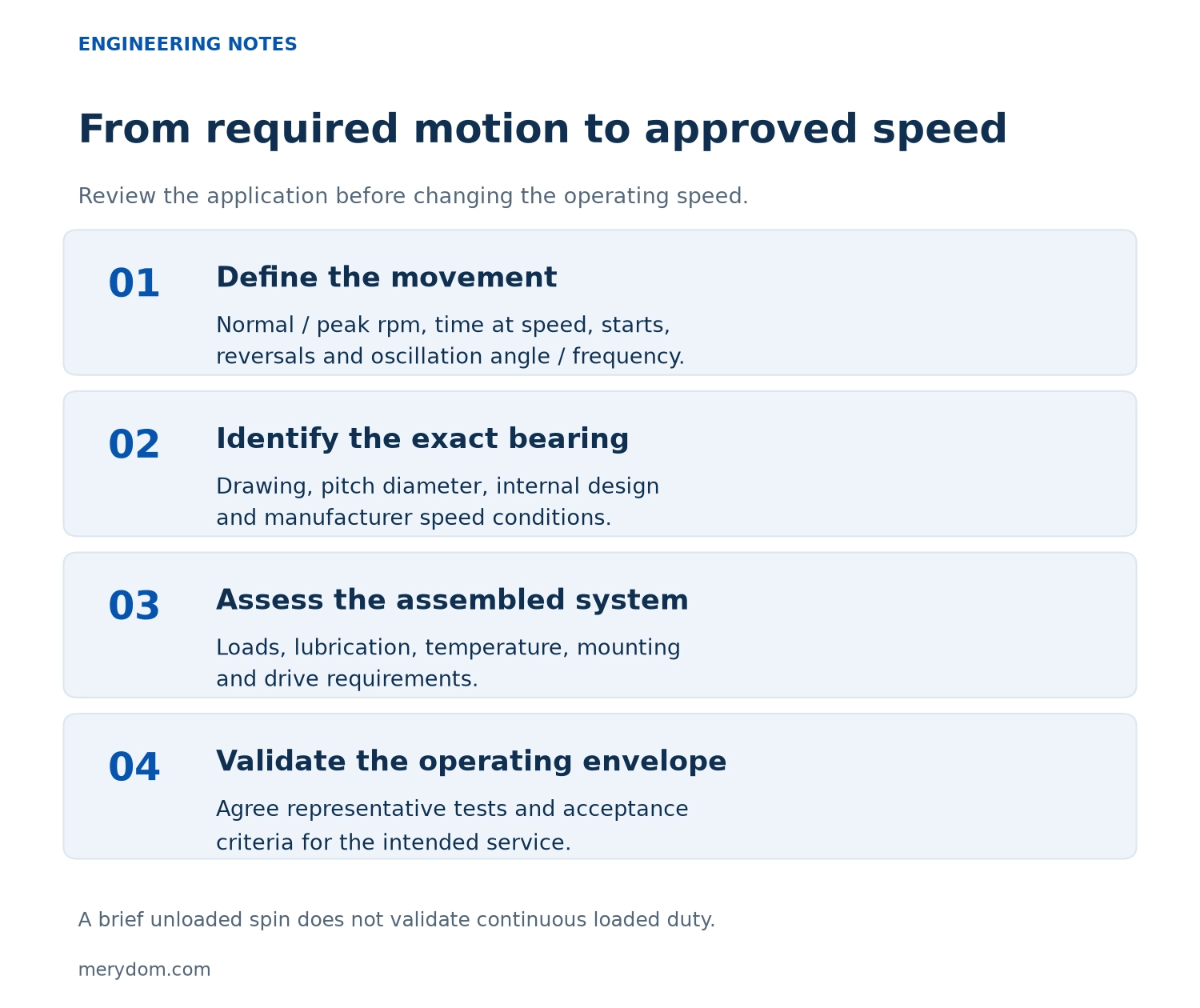
For a new or changed application, agree the validation plan before testing. Depending on the design, it may include temperature behaviour, running torque, lubrication checks and inspection after representative operation. A brief unloaded spin cannot establish suitability for continuous loaded service.
Common questions
What is the maximum rpm of a slewing bearing?
There is no single maximum for all slewing bearings. Obtain the limit for the exact model and application, including whether it applies to continuous operation, intermittent movement or a brief peak. Diameter alone is insufficient.
Can I increase speed if the bearing carries a lighter load?
Possibly, but the change requires review. A lighter load does not remove lubrication, seal, separator or thermal constraints. Do not raise the machine’s speed setting solely because the static load rating appears generous.
Can a stronger motor solve the problem?
A stronger motor can provide more driving torque. It does not raise the bearing’s approved speed or improve its internal lubrication automatically. Check the bearing, gear, pinion and drive as a system before changing the drive settings.
Does early raceway wear prove that the bearing material was poor?
No. Wear should be investigated using the operating history, lubricant condition, mounting, loads and inspection evidence. Operation outside the approved duty is one possible contributor. Appearance alone rarely establishes the root cause.
Specify the movement, not just the bearing size
The most useful lesson is straightforward: the same rpm becomes a higher reference circumferential speed as bearing pitch diameter increases. That explains why larger bearings commonly need lower rpm within a comparable design family.
Before selecting a replacement or increasing machine speed, send MERYDOM the bearing drawing or model, normal and peak speeds, time at each speed, operating loads and lubrication details. For oscillating equipment, include the movement angle and frequency. Use our contact page to submit the application for review.
A well-defined motion profile gives the design engineer something that outside diameter alone cannot: the conditions the bearing must actually survive.
Technical references
- Silverthin — Slewing Ring Bearings: Speed. Manufacturer guidance on typical motion and application-specific speed calculations.
- Schaeffler — Slewing Rings, Catalogue 404. Product overview and circumferential-speed conditions. Catalogue values apply to the specified products and conditions.
- Kaydon — Slewing Ring Bearings, Catalogue 390. Series-specific pitch-line speed guidance and operating-duty considerations.
- SKF — Using a Friction Model as an Engineering Tool. General rolling-bearing friction and lubrication mechanisms; not a slewing-bearing speed rating.
- Escanciano et al. (2024) — Methodology for the assessment of the friction torque of ball slewing bearings considering preload scatter. Friction, 12, 1838–1857. Cited for the reported effects of preload variation and support stiffness.
- Wandel et al. (2022) — Starvation and relubrication mechanisms in grease lubricated oscillating bearings. Tribology International, 165, 107276. Cited for oscillatory lubrication mechanisms, not a general overspeed limit.
The numerical example in this article is a geometric calculation, not a product rating. Apply the bearing manufacturer’s approved limits and the requirements of the complete machine.