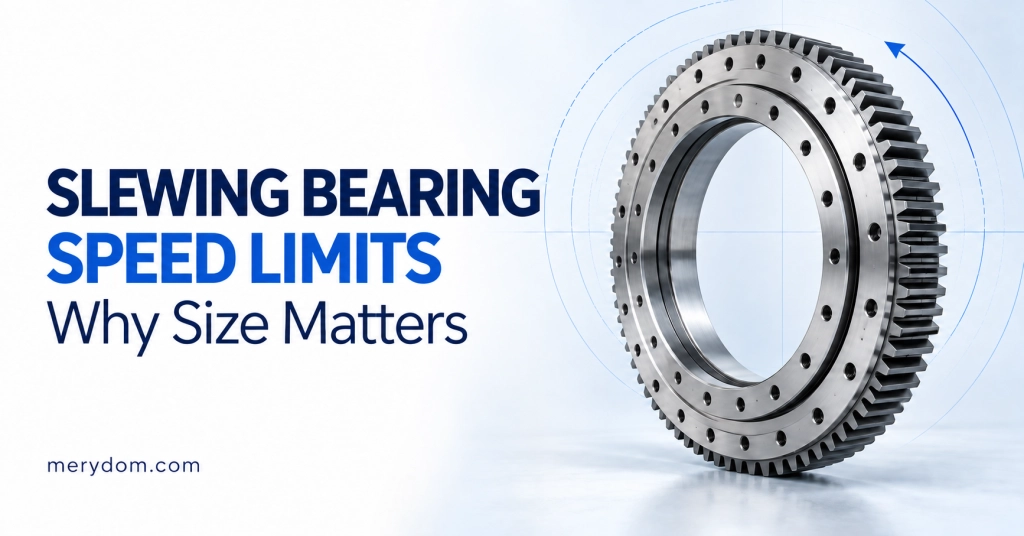
A reference number is the start of a replacement inquiry. See how MERYDOM connects model search, published interface data and engineering review—and where the platform can develop next.
Finding a replacement slewing bearing often starts with a small amount of information: a model number on an old drawing, a nameplate photograph, or the dimensions of a bearing removed from a machine. That may be enough to begin a search. It is rarely enough to place an order with confidence.
The purchasing team needs a clear reference for quotation. The engineer needs to understand the mounting arrangement, bearing configuration and operating requirements. Both need to know which information has been checked and which details still need confirmation.
We built the MERYDOM Slewing Bearing Replacement Platform to bring those early steps together. It connects reference brands and model designations with MERYDOM replacement records, published technical data and a route to engineering support. The purpose is practical: help customers identify a relevant product, examine its interfaces and start a better-informed replacement discussion.
Start with the reference you already have
As of 7 September 2026, the platform displays 2,413 models across 221 product series. Its reference-brand catalog covers IMO, INA, Kaydon, La Leonessa, Liebherr, ROLLIX, Rothe Erde, SKF, Tibet Makina and Torriani Gianni. Gear arrangements include internal gear, external gear and ungeared configurations.
There are two useful ways into that information. If you have the complete reference number, use the model search. If you know the manufacturer or product family, open the brand and series tree. The selected series then gives you a manageable set of records to examine, with filters for model number, gear arrangement and outside diameter.
This structure matters when a maintenance file contains a series name but an incomplete part number, or when several similar references appear in an equipment record. It keeps the search tied to the original designation while allowing the engineering team to inspect the details behind it.
Customers who already know their reference brand can also begin with a guide such as the IMO replacement guide or Kaydon replacement guide. These provide a route into the relevant series rather than requiring a search through the entire catalog.
What a product record tells you
The catalog table brings the initial comparison into one view: model designation, bearing type, available overall dimensions, mounting-hole counts and gear arrangement. Opening a record provides more detail, including published interface data and, where available, outline drawings and load charts.
Consider the 10-16 0100/0-08000 replacement record referencing IMO. It identifies a four-point contact ball bearing with no integral gear. The published data includes an outside diameter of 180 mm, an inside diameter of 40 mm, six mounting holes on each ring, and outer and inner bolt-circle diameters of 140 mm and 60 mm respectively.
Those figures let an engineer begin checking the reference against an existing assembly. They also show why reading the complete record matters. The overall height on this particular page is marked “Not published.” It should be requested and confirmed against the applicable drawing, rather than estimated from the illustration or borrowed from a nearby model.
A similar-looking designation is not sufficient evidence of a match. Keep the complete model number, including suffixes, with the inquiry. Where a public field is missing, make that gap explicit. A useful catalog should help the buyer ask a precise question as well as provide an answer.
What MERYDOM verification means
The platform uses three stages to describe its verification framework:
| Stage | Meaning within the MERYDOM framework |
|---|---|
| Level 1 — Reference Indexed | The reference identity and traceable catalog information have been recorded. |
| Level 2 — Interface Complete | The critical dimensional, mounting, tolerance and gear information is complete and has received manual review. |
| Level 3 — Engineering Verified | An approved MERYDOM drawing and engineering verification record support the stated interchangeability. |
The platform identifies products carrying the MERYDOM Verified mark as Level 3. This is MERYDOM’s own engineering verification framework. Reference-brand names identify the intended cross-reference; they do not imply that the original manufacturer has certified or endorsed the MERYDOM product.
Public product pages and controlled manufacturing documents serve different purposes. The example above states that its evidence date and drawing revision are held in the internal record and confirmed with the quotation. Customers should request the applicable drawing and documentation for the configuration being supplied. The agreed quotation, manufacturing drawing and technical agreement define that supply.
From dimensional comparison to application review
A replacement assessment must connect the bearing to the machine in which it will operate. The installation envelope is one part of that work. Mounting interfaces, the drive arrangement and the operating conditions also need attention.
The platform’s engineering notes identify checks including support flatness, bolt grade and preload, applied loads, duty cycle, lubrication, temperature and the working environment. Its load charts are presented as preliminary selection aids. They need to be considered alongside the mounting structure and the conditions of use.
For a replacement inquiry, the most useful information is:
- The full reference brand and model, together with a nameplate photograph if available.
- The equipment make, model and bearing function.
- An existing drawing, inspection report or measured interface dimensions.
- The gear arrangement and available drive details.
- Known loads, operating speed, duty cycle and environmental conditions.
- Required quantity, destination and target delivery date.
If the bearing is being replaced after damage, include photographs and a description of what happened. A replacement discussion should account for the condition of the existing assembly, not simply repeat its part number. Missing information can be identified at the inquiry stage and taken forward through MERYDOM engineering support.
For a related maintenance case, see When a Port Crane Slewing Bearing Is Beyond Repair: GOTTWALD PMA100216 Failure Analysis.
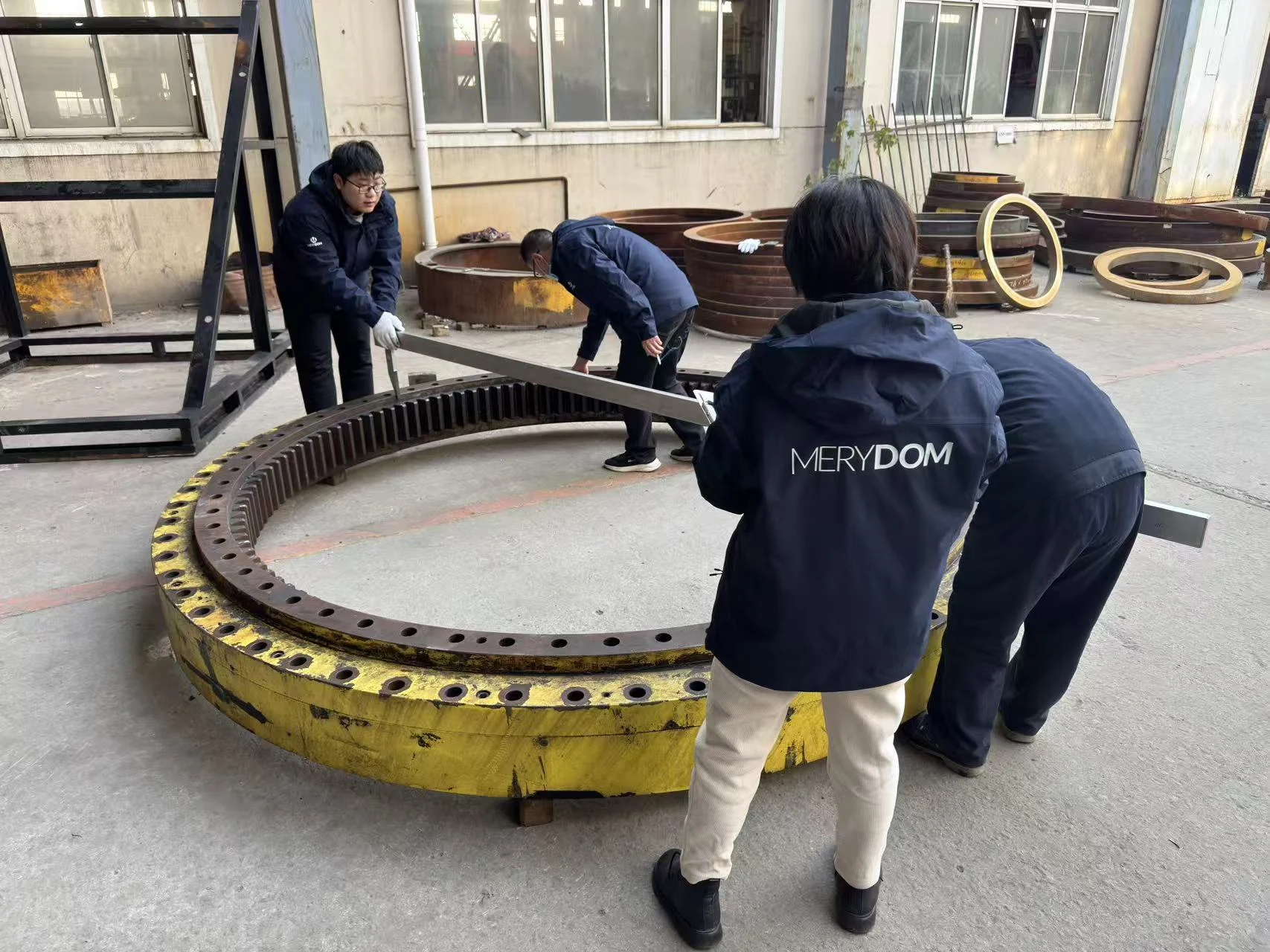
Workshop measurement provides another route to interface information when the original documentation is incomplete.
A catalog connected to the factory
The platform is part of a wider manufacturing service. Once the reference and application have been reviewed, the discussion moves to the supply configuration, drawing approval, inspection requirements and delivery schedule.
That connection is useful for purchasing teams evaluating a new supplier. A model page can establish the starting reference, while the site’s inspection capability and traceability pages help frame the documentation questions to raise with the quotation. Inspection reports, identification requirements and the final document package should be agreed for the order.
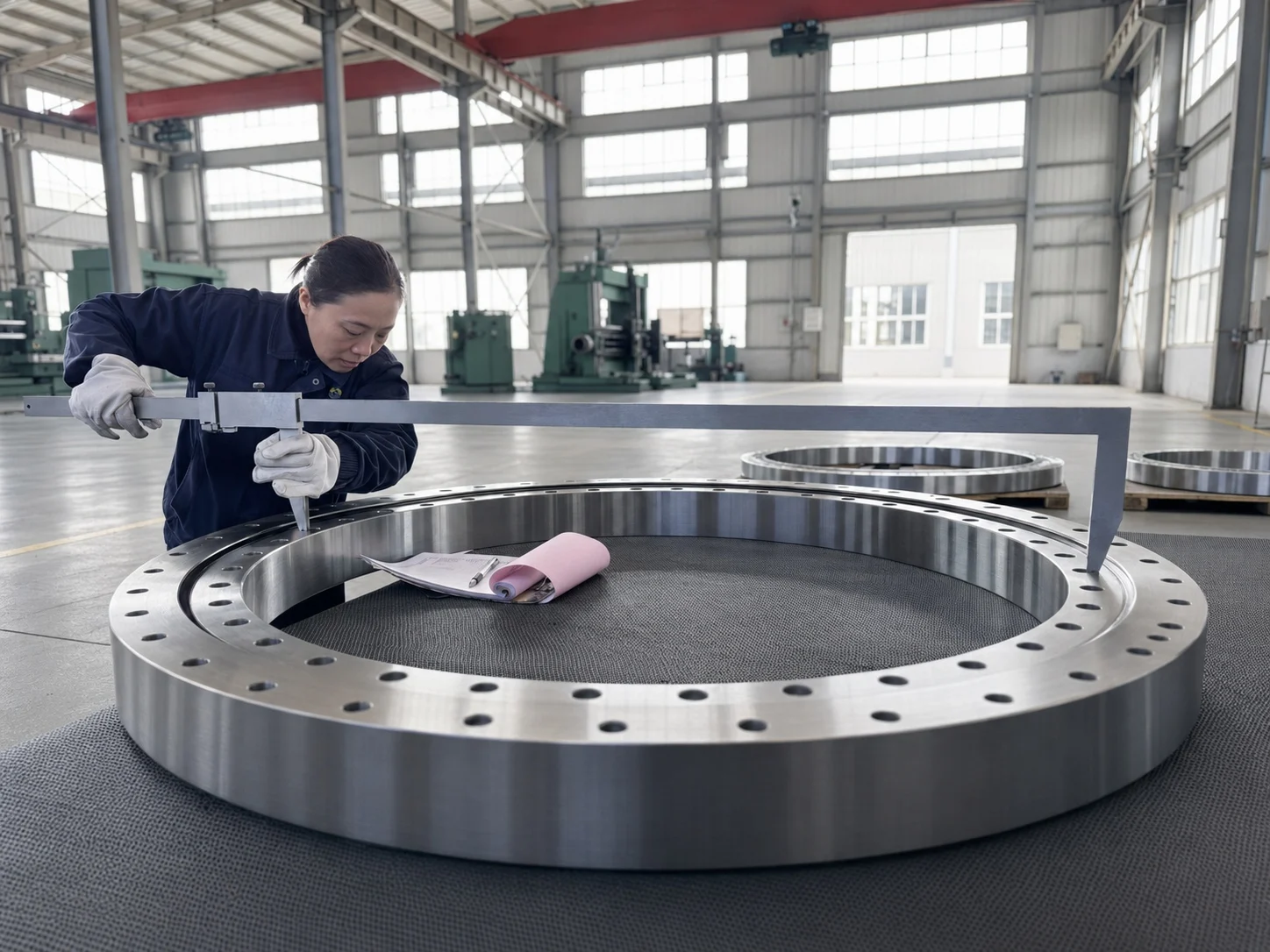
Dimensional inspection is part of the manufacturing work behind a replacement product.
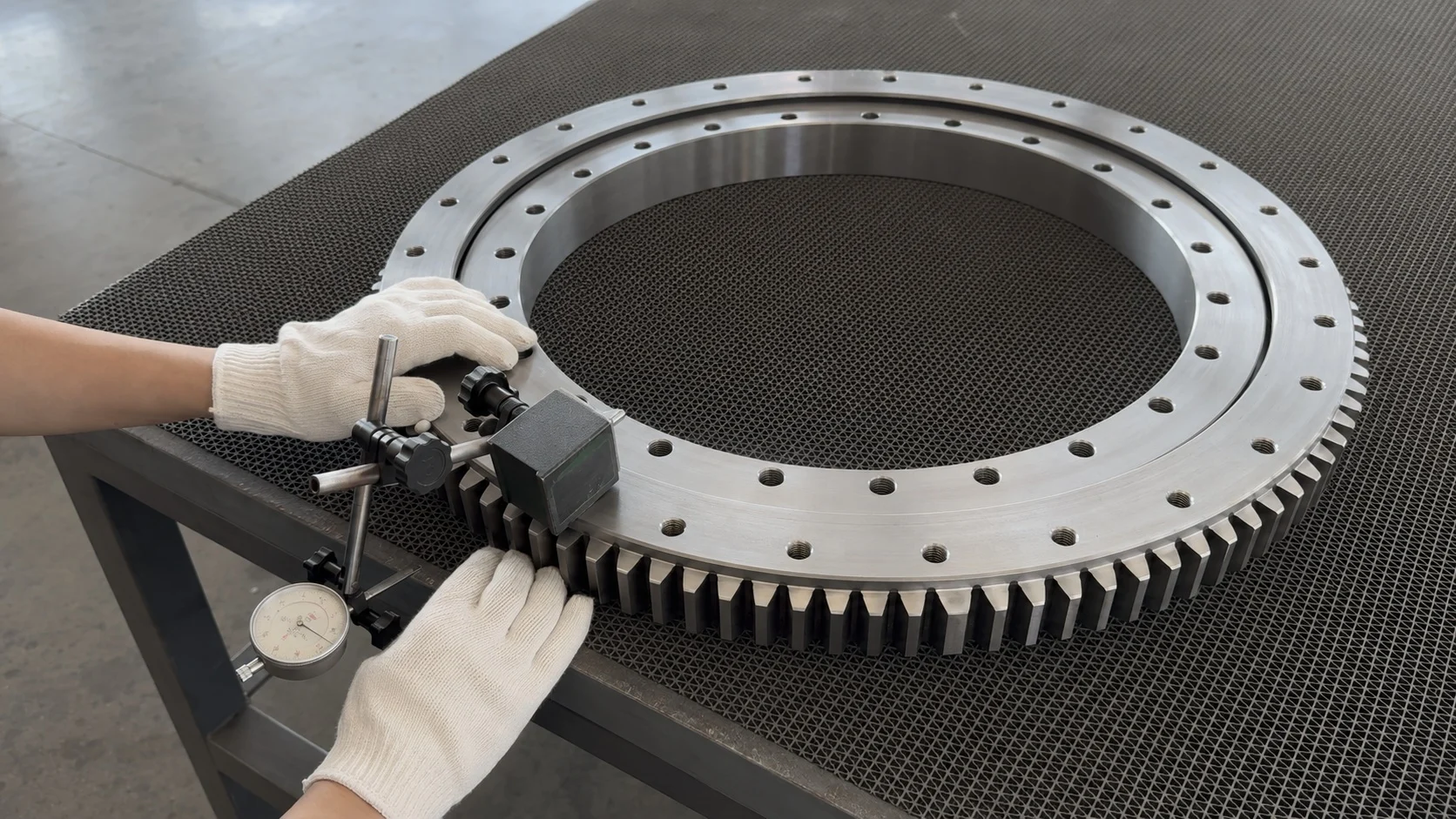
Assembly inspection. The required checks and acceptance criteria should be agreed for the supplied configuration.
For an equipment manufacturer, the starting point may be different. If the design requires a changed interface or a configuration outside the listed references, the custom slewing bearing design and manufacturing route provides a more appropriate basis for discussion. The catalog does not have to contain every possible project to be useful.
If your model is not listed
An unsuccessful search does not establish that a replacement is unavailable. The reference may be outside the current coverage, recorded in another format, or require information that is not yet in the public catalog.
The platform includes a model-submission route through the contact page. Send the reference you have, along with any drawing or photographs, and explain the application. It is better to preserve an uncertain reference for review than to select the nearest-looking model and assume it will fit.
For maintenance teams, this makes the platform useful even before every technical detail is known. It gives the inquiry a starting point and helps identify the information required for the next decision.
Where the platform can develop next
The most useful development priorities follow from these everyday tasks. Broader coverage is one direction, particularly where customers repeatedly request an unlisted brand, series or model. Each addition should retain a clear connection between the reference information and the engineering basis for the replacement.
Greater depth in existing records is equally valuable. More accessible interface details, clearer drawing-revision information and an explicit explanation of unpublished fields would help customers prepare an inquiry with fewer unresolved questions.
Search and comparison are another area for development. Better handling of model-number formatting, clearer differences between related variants and easier sharing of a selected record could make collaboration between maintenance, engineering and purchasing more straightforward.
There is also room to connect catalog references with documented replacement work: the original application, the checks performed, the approved solution and the inspection evidence. Such cases can help a reader understand the process, provided the experience from one machine is not presented as proof for every other installation.
These are development directions, rather than an announcement of released functions or a fixed delivery schedule. Their value should be judged by a simple question: does the improvement help a customer reach a sound replacement decision with clearer information?
Begin with a model, a drawing or a question
If you have a reference number, open the replacement catalog and examine the matching record. Check the published interfaces, note any missing details, and keep the product link with your project information.
When you are ready to discuss a replacement, send MERYDOM your model, quantity and application details. If all you have is an old bearing and a photograph, start there. The next step is to establish what can be confirmed and what needs further investigation.
MERYDOM is an independent manufacturer. Third-party names and model numbers are used to identify cross-references. Application suitability and the final supplied configuration remain subject to the agreed engineering and order documents.