
How MERYDOM manufactured, inspected and shipped a 6-metre-class three-row roller slewing bearing for a Thai port equipment service company.
A port equipment service company in Thailand found MERYDOM through merydom.com and sent us the drawing and technical requirements for a replacement bearing of exceptional scale: a custom three-row roller slewing bearing with an outside diameter exceeding six metres.
The assignment went well beyond machining a large steel ring. MERYDOM had to translate the customer’s drawing into a controlled manufacturing plan, manage large-diameter geometry and gearing through production, support customer acceptance, and then solve the practical problem of moving an over-width precision component from Xuzhou to Shanghai Port for breakbulk shipment.
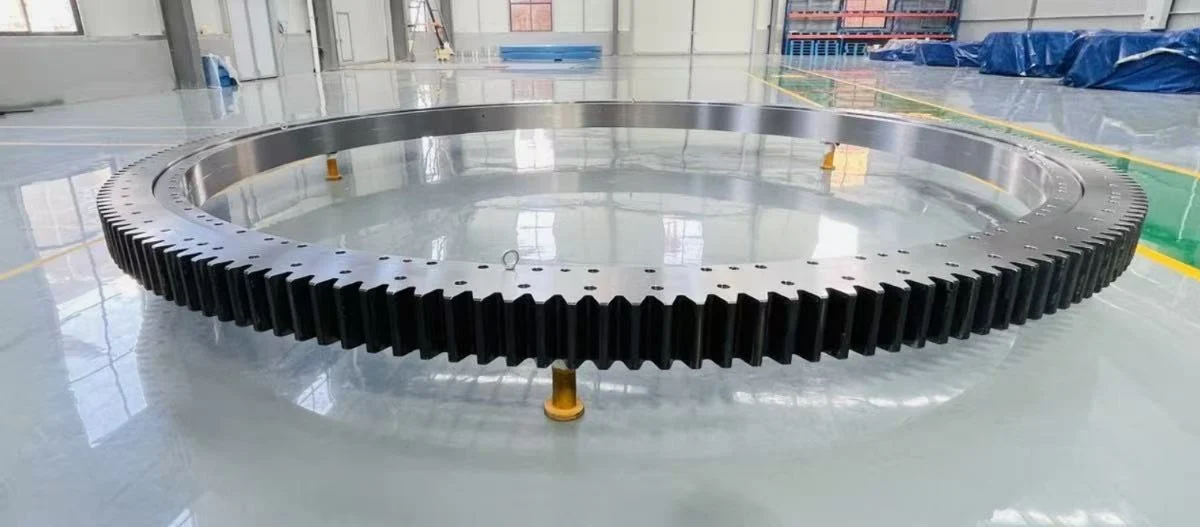
Project at a glance
| Customer | Port equipment service company in Thailand |
|---|---|
| Bearing | Custom three-row roller slewing bearing with external gearing |
| Size class | Outside diameter exceeding 6 metres |
| Starting information | Customer drawing and project-specific technical requirements |
| MERYDOM scope | Engineering review, manufacturing coordination, quality control, customer acceptance support, export protection and oversized logistics |
| Transport route | Xuzhou manufacturing base → Shanghai Port → breakbulk vessel to Thailand |
Commercially sensitive dimensions, tolerances, load data and acceptance values remain part of the customer’s controlled project documentation. This case therefore focuses on the engineering and delivery process rather than disclosing the customer’s proprietary drawing.
From a website inquiry to an engineering project
The customer’s first contact came through MERYDOM’s website. For a bearing of this size, a drawing is the beginning of the technical conversation—not the end of it. Before production planning, the project team reviewed the information that governs whether the bearing can be manufactured, installed and operated as intended:
- ring arrangement and raceway configuration;
- outside, inside, pilot and mounting-interface diameters;
- overall and individual ring heights;
- mounting-hole quantity, pitch circles and hole requirements;
- gear module, tooth count, pressure angle and mating-pinion requirements;
- internal clearance and rotational requirements;
- material, heat-treatment and surface-protection requirements;
- inspection, documentation, marking and acceptance criteria; and
- packing, lifting and transport constraints created by the six-metre envelope.
This review connected the customer’s approved design with the actual manufacturing route. It also allowed quality checkpoints and logistics considerations to be defined before the first major production operation. MERYDOM applies the same disciplined approach through its custom slewing bearing design and manufacturing service.
Why a six-metre three-row roller bearing is a different manufacturing challenge
A three-row roller slewing bearing separates axial, radial and tilting-moment loads across different roller rows. This architecture offers high load-carrying potential and is widely relevant to heavy port and lifting equipment, but the benefits depend on accurate geometry across every load path.
When the diameter passes six metres, small local deviations can become significant around the full circumference. Ring support, clamping force, machining sequence, temperature, measurement method and handling all influence the final result. A process that is stable for a smaller bearing cannot simply be enlarged without review.

MERYDOM’s manufacturing plan therefore treated the bearing as an integrated system of rings, raceways, rollers, gear teeth, mounting interfaces, lubrication paths and seals. The sequence had to protect dimensional consistency from ring preparation through final assembly.
Large-diameter machining and gear production
The project required equipment with both the physical envelope and the process stability to work on rings of this diameter. The selected route combined large vertical machining capacity with dedicated gear-processing operations.
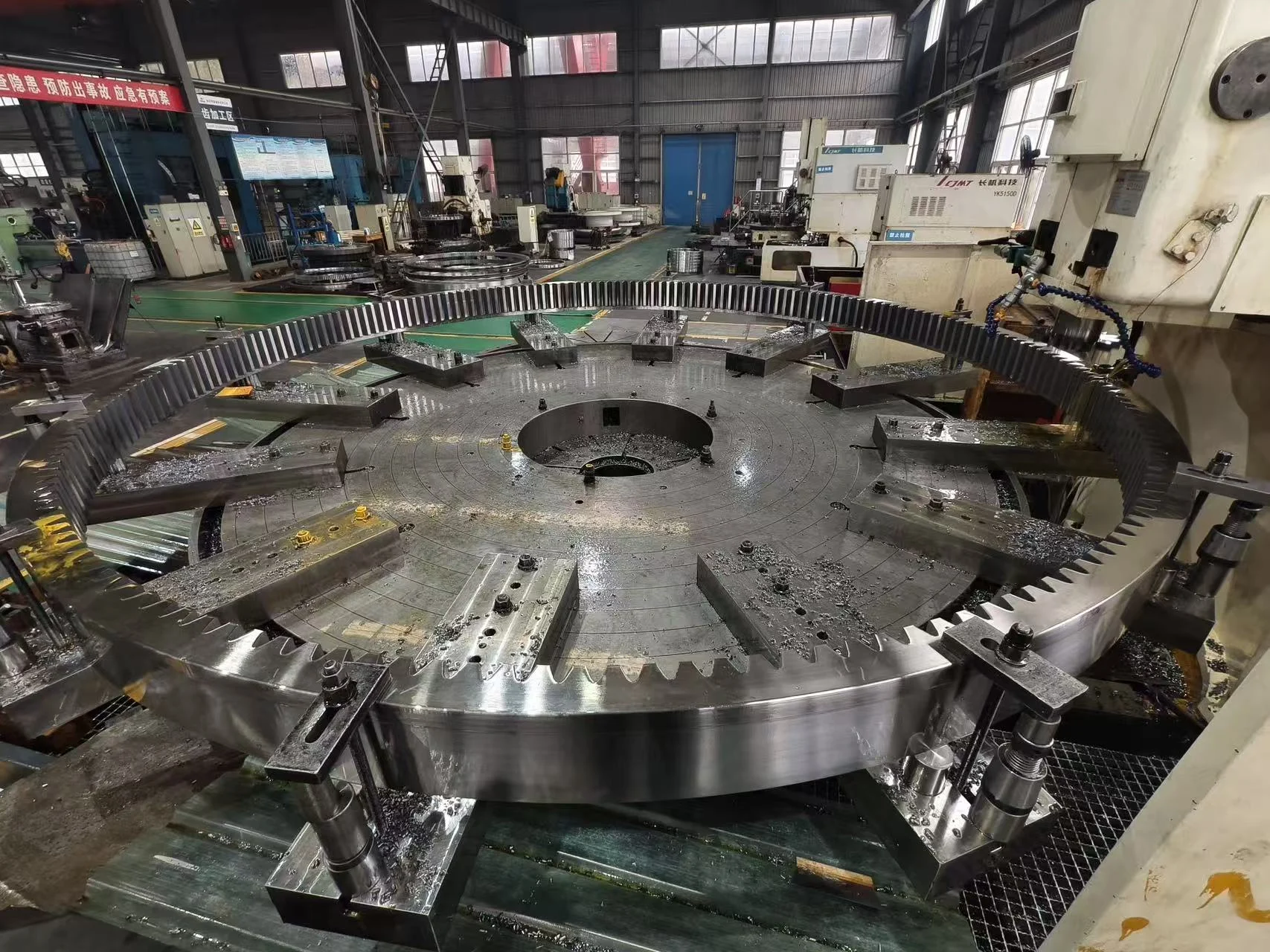

At this scale, each setup matters. The project team planned datum references, ring support and inspection points so that information from one operation remained usable at the next. Critical dimensions were checked during production rather than waiting for final inspection to discover accumulated error.
The external gear also had to work as part of the customer’s drive system. Gear geometry, mounting-hole relationships and bearing datums were considered together, because a ring can meet an isolated diameter requirement and still create problems if its interfaces do not align with the machine.
Readers can see more of the manufacturing environment on the MERYDOM factory and workshop and production equipment pages.
Assembly and quality control: managing the complete load path
After ring and gear processing, the bearing components moved through the controlled assembly and verification stages. A three-row roller bearing requires the three roller systems to work together; quality cannot be reduced to checking only one finished diameter.

The project quality plan connected incoming records, in-process inspection and final acceptance. Depending on the drawing and agreed inspection scope, the controlled characteristics include material traceability, heat-treatment records, raceway geometry, gear data, mounting interfaces, ring heights, clearances, rotational behaviour, lubrication provisions, seals, marking and corrosion protection.
That documentation chain matters on port equipment. The bearing becomes a safety-critical structural and rotational interface, so the customer must be able to connect the delivered component to the approved drawing and inspection evidence. MERYDOM’s quality control system is designed around this traceable project flow.
With manufacturing and verification complete, the bearing passed the agreed acceptance process and was released for shipment. Customer acceptance was not treated as a separate ceremonial step; it was the conclusion of the controls built into the project from the drawing review onward.
Export protection for a precision component of exceptional size
A finished slewing bearing remains vulnerable after it leaves the inspection area. Moisture, dust, impact, poor lifting practice or uneven support during transport can compromise surfaces and geometry before installation.
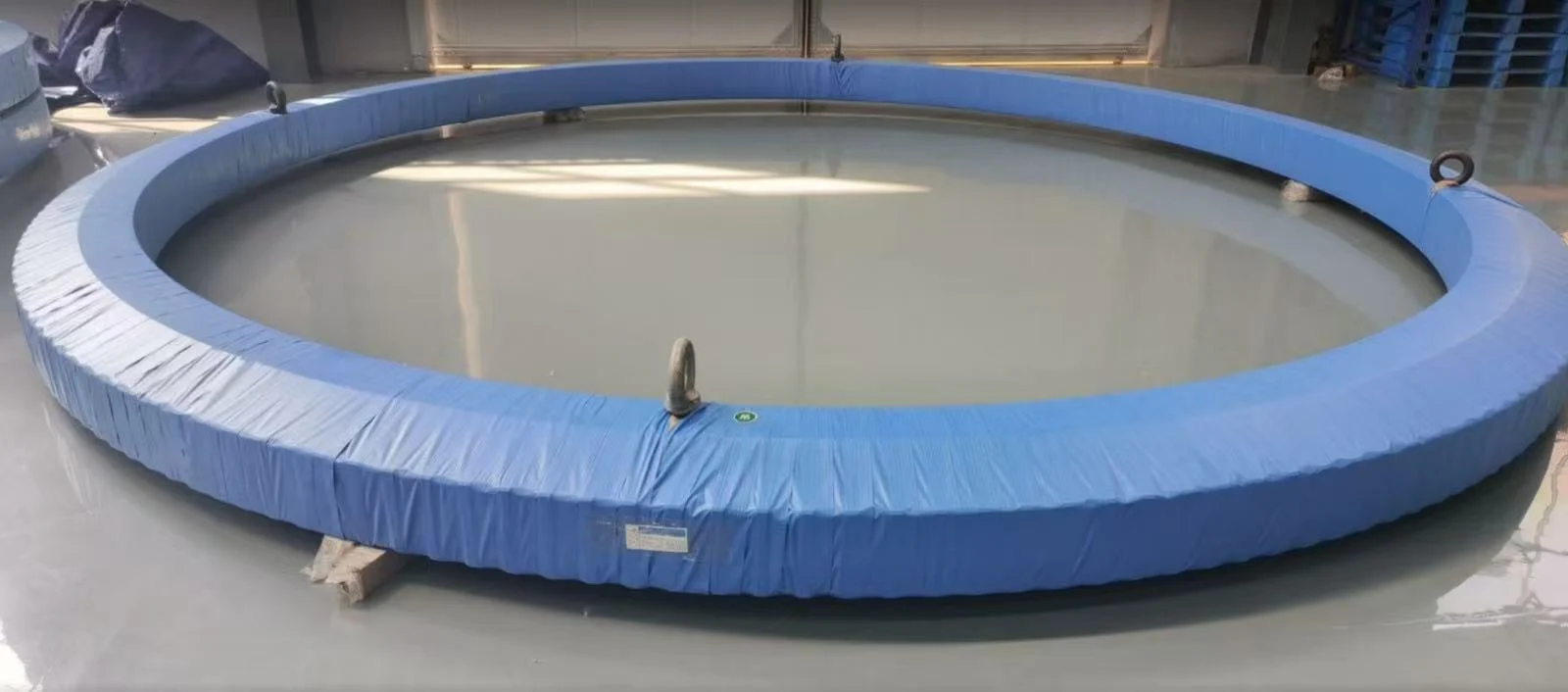
MERYDOM prepared the bearing for the route rather than applying a generic packing method. The protection and support arrangement considered the large open-ring geometry, lifting access, contact points, road vibration, temporary storage and exposure during port handling. Handling information accompanied the cargo so that the bearing could be transferred without improvising lifting or support positions.
Oversized logistics from Xuzhou to Shanghai Port
With an outside diameter exceeding six metres, the bearing could not move as ordinary container cargo. MERYDOM coordinated a dedicated over-width road transport solution from the Xuzhou manufacturing base to Shanghai Port.

The logistics work included matching the bearing and its support arrangement to the vehicle, reviewing the transport envelope, coordinating loading and securing, and aligning the road movement with port receiving arrangements. The objective was not simply to make the cargo fit on a trailer; it was to preserve the accepted condition of a precision bearing through every handover.
At Shanghai Port, MERYDOM worked with its logistics partners to arrange breakbulk vessel space and terminal handling suitable for the cargo dimensions. The bearing was delivered to the port and successfully loaded for shipment to Thailand.
What this project demonstrates
This project brought four capabilities together:
- Engineering interpretation. The team converted the customer’s drawing and requirements into a manufacturable, inspectable and deliverable project plan.
- Giant-bearing manufacturing. MERYDOM coordinated the equipment, setups and process controls needed for a three-row roller slewing bearing beyond six metres in diameter.
- Traceable quality management. Inspection and acceptance were connected to the approved requirements throughout production.
- End-to-end delivery ownership. Export protection, special road transport, port coordination and breakbulk loading were managed as part of the same technical delivery.
For port operators, equipment service companies and OEMs, this integration reduces the gaps that often appear between drawing review, manufacturing, inspection and logistics. The supplier responsible for the bearing remains engaged until the product is ready to enter the customer’s delivery chain.
The same approach supports other heavy-duty applications covered by MERYDOM’s slewing bearings for port machinery engineering guide.
Planning a large-diameter slewing bearing project?
For a technical review, send the available bearing drawing, application and machine information, load cases, gear data, mounting interfaces, material and inspection requirements, required delivery date, and destination. Early information about transport restrictions is especially important when the bearing diameter exceeds normal road or container limits.
MERYDOM can support the project from engineering review and manufacturing through inspection, export packing and oversized international logistics.